





All | Math | Science/Technology | Extracurricular | Humanities / Social Sciences | Art/Music | Language Arts | Foreign Languages
Acrylic Painting: Open Studio (Q2)
Quarter 2: Starts on October 30, 2026
Class Time: 2:00 pm Duration: 85 min
Instructor: Pete Van Riper
Grade Range: 9th-12th
Prerequisites:
Students will be introduced to painting with acrylics in a relaxed, informal studio setting under the guidance of a professional art instructor. Students will work on canvas boards and will learn elements of art, principles of design, and color theory in addition to methods in painting. Each week, the instructor will demonstrate a different technique in acrylic painting rather than a different subject. Techniques will include mixing and blending paints, wet and dry brush techniques, sponge techniques, glazing, washing, gradient relief, sgraffito, impasto, smudging, dot techniques, stippling, pouring, splattering, dabbing, underpainting, and detailing. The emphasis will be on methods and effects so that each student has a "toolbox" of techniques for working in acrylics. Students will have the freedom to mix and match the techniques that they have learned to create original pieces. In the open studio concepts, each student will have a different goal and unique project in-progress such as still life, floral, landscape, portrait, fantasy, abstract, or pop art. Student will complete two or three boards each quarter, depending on the level of detailing.
This class is suitable for beginners who have never painted before, and for experienced art students who have worked in other mediums and are interested in exploring acrylic painting. Compass parents are welcome to register for this class to work alongside their teens, or to work on their own, while their teen is in another Compass class. Painting can provide a relaxing, needed break from rigorous academic classes and over-scheduled lives in a fun, supportive environment.
Prerequisites: None
Workload: Work outside of class is optional, however students who want to continue to practice their painting techniques might want to purchase a tabletop easel (approx. $10.00) and set of basic acrylic paints ($30.00+) for home use.
Assessments: Individual feedback is given in class. Formal assessments will not be given.
Lab/Supply Fee: A supply fee of $25.00 is due payable to the instructor on the first day of class for up to 6 canvas boards and shared class supplies (paints, brushes, paper products, etc.). Students who paint more quickly need more than 6 boards can purchase additional ones from the instructor for $4.00/each.
What to Wear: Students may wish to wear an apron, smock, or paint shirt when working with acrylic paints.
Credit: Homeschool families may wish to count this course as a component (partial) credit in Fine Arts for purposes of a high school transcript.
Acting- Detective Drama: The Computer Caper
Quarter 2: Starts on October 27, 2026
Class Time: 11:00 am Duration: 55 min
Instructor: Judith Harmon
Grade Range: 4th-6th
Prerequisites:
Calling crooked criminals who commit creepy crimes! Convening colorful characters who corroborate clues and constables who collaborate to crack the case! Connect with a kooky cast in Detective Drama. Using materials from a commercial mystery role playing game (RPG), students will be guided through the facts of a fictitious case. Student sleuths will be follow clue cards, eclectic evidence, and phony forensics to uncover a crime. Emphasis will be on critical thinking, problem solving skills, and improvisation through the portrayal of unique characters involved in the crime. Students will be encouraged to develop a strong, compelling character, an original costume, a backstory, and of course, an alibi.
Second quarter, students will aid Detective Davis, the sleuth overseeing the case of a crafty computer virus. At a large company, the cranky corporate officer accused an astute accountant of the crime. They discovered that $3 million dollars were disbursed as dubious deposits. Cleve clue-catching Compass crusaders must collaborate to crack the code and capture the cyber culprit.
In this workshop, students will experiment with acting and improvisation and working as a team. This class is best suited for students who are active listeners, are flexible and easily adapt, have a sense of humor, and enjoy working in a collaborative group. Students need to be able to stay in sync with the flow of the class. This is not an "anything goes" or free-for-all class. Because of the age of the students in this class, only capers such as burglaries or kidnappings will be portrayed instead of murders.
Topics in this Series: Missing from the Museum (Quarter 1), The Computer Caper (Quarter 2), Pocketing the Prized Jewels (Quarter 3), and Brazen Bank Robbery (Quarter 4). There is a class supply fee of $20.00 due payable to the instructor on the first day for the class RPG materials, printing, props, and investigation folders.
Acting- Kids' Theater: Mystery after Midnight
Quarter 2: Starts on October 27, 2026
Class Time: 1:00 pm Duration: 55 min
Instructor: Judith Harmon
Grade Range: 3rd-5th
Prerequisites:
Kids take to the stage as they collaboratively write and perform their very own play with unique characters and an original storyline. What happens by the light of the midnight moon? What trouble lurks in the twilight? What dangers are disguised in the dark?
Students will begin with improvisational games to get to know each other and start to brainstorm about their original play. Through group activities and guided discussion, the student actors will decide on characters, conflict, and conclusion, and the story they want to tell. The script will be developed and customized for this class with input from the students.
The class will learn the practical aspects of acting, as they work on script read-through, blocking, costume/prop design, and planning the show. Student actors will explore skills such as stage movement, character development, emotional expression, and observation/concentration while learning to portray their original character. Students will develop their own "actor's toolkit" of voice, body, and imagination in this creative process! Actors will grow in confidence and communication skills in preparation for a final sharing with parents on the last day of the quarter.
Once the script is fully developed with everyone's parts, it will be emailed to parents. Parents will be expected to help their children memorize their script/lines/cues and assemble a simple make-at-home costume, ideally from clothing items and accessories you already own and a little creativity.
Note: Students who are emerging readers (not able to read at a 3rd/4th grade level) would be better suited to the Young Actor's Playhouse class, rather than this level.
Topics in this series: Camping Catastrophe (Quarter 1), Mystery After Midnight (Quarter 2), Fractured Fairy Tales (Quarter 3), and Upside-Down Universe (Quarter 4).
Acting- Kids' Theater: Wacky Wednesday
Quarter 2: Starts on October 29, 2026
Class Time: 11:00 am Duration: 55 min
Instructor: Judith Harmon
Grade Range: 3rd-5th
Prerequisites:
Kids take to the stage as they collaboratively write and perform their very own play with unique characters and an original storyline. What happens when Wednesday gets weird and wild? Our actors will create crazy characters and silly scenes to explain what happened when Wednesday went awry.
Students will begin with improvisational games to get to know each other and start to brainstorm about their original play. Through group activities and guided discussion, the student actors will decide on characters, conflict, and conclusion, and the story they want to tell. The script will be developed and customized for this class with input from the students.
The class will learn the practical aspects of acting, as they work on script read-through, blocking, costume/prop design, and planning the show. Student actors will explore skills such as stage movement, character development, emotional expression, and observation/concentration while learning to portray their original character. Students will develop their own "actor's toolkit" of voice, body, and imagination in this creative process! Actors will grow in confidence and communication skills in preparation for a final sharing with parents on the last day of the quarter.
Once the script is fully developed with everyone's parts, it will be emailed to parents. Parents will be expected to help their children memorize their script/lines/cues and assemble a simple make-at-home costume, ideally from clothing items and accessories you already own and a little creativity.
Note: Students who are emerging readers (not able to read at a 3rd/4th grade level) would be better suited to the Young Actor's Playhouse class, rather than this level.
Topics in this series: Medieval Mayhem (Quarter 1), Wacky Wednesday (Quarter 2), Spy Spoof (Quarter 3), Kooky Cooking Contest (Quarter 4).
This is a 6-week class that does not meet on December 10.
Acting- Morning Mystery: Murder in the Museum
Quarter 2: Starts on October 28, 2026
Class Time: 10:00 am Duration: 55 min
Instructor: Judith Harmon
Grade Range: 6th-8th
Prerequisites:
Who doesn't love a good "Whodunnit" mystery? In this workshop, tween actors will work together to bring a cast of characters to life through creative adaptations and interpretive improvisation. Using materials from a commercial murder mystery role playing game (RPG), students will assume the personas of outrageous and offbeat characters. As the drama unfolds in rounds guided by clue cards, eclectic evidence, and fictitious forensics, a victim, a motive, and eventually the guilty party will be revealed.
Step softly into the stately halls of the National Archaeological Museum, where history hums and horrors hide. Tonight's tantalizing treasure? The Guardian of Atzul- a cursed curiosity cloaked in chilling legend. Guests gather, gossip grows, and the atmosphere thickens with tension. Then, tragedy strikes. Is it the curse? Or cunning conspirators crafting chaos behind closed cases? Schemes swirl, scandals simmer, and suspicion stalks every shadow. Stay sharp! This mystery is more menacing than myth.
Student actors will be guided through the development of a strong, compelling character, complete with unique ways of speaking, gesturing, and moving, an original costume, a backstory, and of course, an alibi. In this workshop, students benefit from experimenting with acting and improvisation and working as a team. This class is best suited for students who are active listeners, are flexible and easily adapt, have a sense of humor, and enjoy working in a collaborative group. Students need to be able to stay in sync with the flow of the class. This is not an "anything goes" or free-for-all class.
Supply Fee: A class fee of $25.00 is due payable to the instructor on the first day of class for a script and costs related to props and performance license fee.
Topics in this series: Faireground Foul Play (Quarter 1), Murder in the Museum (Quarter 2), Grisly Golden Gala (Quarter 3), and Highlands Homicide (Quarter 4).
Acting- Young Actor's Playhouse: Outback Odyssey
Quarter 2: Starts on October 27, 2026
Class Time: 12:00 pm Duration: 55 min
Instructor: Judith Harmon
Grade Range: 1st-2nd
Prerequisites:
Acting is an adventure! Young actors work together to create and perform their very own play with unique characters and an original storyline. G'day mate! What happens when kind kangaroos and devilish dingoes meet in the dry desert of arid Australia?
Students will begin with improvisational games to get to know each other and to begin to brainstorm about their original play. Through group activities and guided discussion, the young actors will decide on characters, conflict, and conclusion, and the story they want to tell. The script will be developed and customized for this class with input from the students.
Young actors will explore skills such as sensory awareness, listening, stage movement, character development, emotional expression, and observation/concentration while learning to portray their original character. Young actors will learn aspects of acting by script read-through, blocking, costume/prop discussion, and planning the show. Through individual and group activities, young actors build confidence in preparation for a final sharing for parents.
Students will work from a simple, written script, but emerging readers can be accommodated. Parents will be emailed the script after the 3rd or 4th class and will be expected to help their children memorize their lines and assemble a simple make-at-home costume, ideally from clothing items and accessories you already own and a little creativity. All actors must be at least age 6 to sign up for this class.
Topics in this series: Pirate's Paradise (Quarter 1), Outback Odyssey (Quarter 2), Suddenly Small (Quarter 3), and Clown College (Quarter 4).
Adventures in Art: Creatures in Color (TUE)
Quarter 2: Starts on October 27, 2026
Class Time: 11:00 am Duration: 55 min
Instructor: Kerry Diederich
Grade Range: 3rd-4th
Prerequisites:
Adventures in Art is an engaging, hands-on creative experience designed for growing artists! Each week, students will explore a new artist or artistic style, learn interesting background facts, study inspiring examples, and create their own artwork inspired by what they observe. Working with a wide variety of materials, students will experiment with color, pattern, texture, and design as they develop their skills and bring their creative ideas to life.
Second quarter, students bring animals to life through art using a wide range of styles, colors, and techniques. Each class explores a fun new way to create, then students jump in to design their own animal artwork, from realistic creatures to bold, imaginative designs. Along the way, they experiment with color, pattern, and texture while building creativity and confidence. Featured artists include Winslow Homer, Paul Gauguin, Franz Marc, and Dean Russo.
A partial list of projects this quarter includes: colorful jungle animal painting, animal in nature watercolor, expressive animal portrait, animal pattern design, habitat scene collage, mythical creature drawing, and animal silhouette at sunset painting using pencils, erasers, black markers, colored pencils, crayons, oil pastels,
watercolor and tempera paints, paintbrushes, white drawing paper, canvases, colored construction paper, cardstock, tissue paper, cardboard, glue sticks, liquid glue, and scissors.
Topics in this series include: Stellar Celestial Subjects (Quarter 1), Creatures in Color (Quarter 2), A Tale of Two Styles (Quarter 3) and Murals, Monuments & Museums (Quarter 4).
Adventures in Art: Creatures in Color (WED)
Quarter 2: Starts on October 28, 2026
Class Time: 12:00 pm Duration: 55 min
Instructor: Kerry Diederich
Grade Range: 3rd-4th
Prerequisites:
Adventures in Art is an engaging, hands-on creative experience designed for growing artists! Each week, students will explore a new artist or artistic style, learn interesting background facts, study inspiring examples, and create their own artwork inspired by what they observe. Working with a wide variety of materials, students will experiment with color, pattern, texture, and design as they develop their skills and bring their creative ideas to life.
Second quarter, students bring animals to life through art using a wide range of styles, colors, and techniques. Each class explores a fun new way to create, then students jump in to design their own animal artwork, from realistic creatures to bold, imaginative designs. Along the way, they experiment with color, pattern, and texture while building creativity and confidence. Featured artists include Winslow Homer, Paul Gauguin, Franz Marc, and Dean Russo.
A partial list of projects this quarter includes: colorful jungle animal painting, animal in nature watercolor, expressive animal portrait, animal pattern design, habitat scene collage, mythical creature drawing, and animal silhouette at sunset painting using pencils, erasers, black markers, colored pencils, crayons, oil pastels,
watercolor and tempera paints, paintbrushes, white drawing paper, canvases, colored construction paper, cardstock, tissue paper, cardboard, glue sticks, liquid glue, and scissors.
Topics in this series include: Stellar Celestial Subjects (Quarter 1), Creatures in Color (Quarter 2), A Tale of Two Styles (Quarter 3) and Murals, Monuments & Museums (Quarter 4).
AI Applied Lab: Ask, Refine, Realize
Quarter 2: Starts on October 28, 2026
Class Time: 10:00 am Duration: 55 min
Instructor: Veronica Calancha
Grade Range: 7th-8th
Prerequisites:
In this course, middle schoolers will expand their understanding of how AI works and begin to evaluate its role in the real world. They will explore core concepts behind AI systems, improve their ability to communicate with AI tools, and examine important topics such as fairness, bias, and ethical use.
How do you move from basic questions to powerful, precise control of AI? Second quarter, students take their skills to the next level by learning advanced prompting techniques and how to evaluate and refine outputs. They will design multi-step prompts, experiment with different approaches, and optimize results for clarity, accuracy, and creativity. Through prompt engineering challenges and hands-on workshops, students will test what works, improve what doesn't, and create original content using AI.
Technology access in this class will include both instructor-led demonstrations with classroom projections, and hands-on individual laptop use with safety constraints and limited distractions.
Topics in this series include: Inside the System (Quarter 1), Ask, Refine, Realize (Quarter 2), Truth or Manipulated? (Quarter 3), and Build for Impact (Quarter 4).
AI Apprentice Lab: Ask Perfect Prompts
Quarter 2: Starts on October 28, 2026
Class Time: 11:00 am Duration: 55 min
Instructor: Veronica Calancha
Grade Range: 5th-6th
Prerequisites:
This class moves students beyond basic understanding and into actively using AI as a tool for learning, problem-solving, and creativity. Students will explore how AI systems work, practice writing more precise prompts to improve results, and learn to identify errors and bias in AI responses. Through hands-on activities, students will strengthen their critical thinking while gaining practical experience.
How can you get better results from AI? Second quarter, students learn how to communicate clearly and effectively with AI by crafting strong prompts. They will explore how small changes in wording can lead to big differences in output and begin to understand the cause-and-effect relationship between input and results. Through engaging activities like prompt battles, rewriting challenges, output comparisons, and an AI-themed escape room, students will practice refining their questions to guide AI more successfully.
The focus is on helping students become thoughtful, confident users who can direct and evaluate AI effectively, rather than simply relying on it. Technology access in this class is instructor-led demonstrations with classroom projections, supported by small group stations with one laptops per 2 to 3 students.
Topics in this series include: How It's Built (Quarter 1), Ask Perfect Prompts (Quarter 2), Fair or Flawed (Quarter 3), and Real-World Solitions (Quarter 4).
Algebra I (Tue, Fri)
Quarter 1,2,3,4: Starts on September 9, 2025
Class Time: 11:00 am Duration: 55 min
Instructor: David Chelf
Grade Range: 7th-10th
Prerequisites: Pre-Algebra
This is a complete course in high school Algebra I which will cover fundamental concepts in algebra and provide a solid foundation of mathematical literacy, problem solving, reasoning, and critical thinking skills that are necessary for the exploration of more advanced and rigorous topics in mathematics. This course is designed to emphasize the study of algebraic problem-solving with the incorporation of real-world applications. Topics in Algebra I include number systems, linear systems, rational numbers, complex numbers, exponents, roots, radicals, quadratic equations, polynomials, factoring, absolute values, ratios, and proportions. In addition, the course will cover solving and graphing systems of functions, linear equations, and inequalities. Students will explore these topics through class discussions, practice problems, and open-ended problem-solving.
Prerequisite: Students should have a solid foundation in pre-algebra topics in order to take this class. In addition, students should be capable of copying the sample problems and solutions worked in class on the white board to his/her own notes as examples for completing homework.
Workload: Students should expect to spend 1-1.5 hours per day on reading, review, and homework on most non-class days. Homework assignments will run on a 7-day cycle, with assignments posted on Thursdays and due the following Thursday. Students are advised to start homework once it is assigned (i.e., not wait until the night before it is due). Weekly homework assignments will be of a length that a student should be able to complete them in two or three at-home work sessions. Solutions will be provided for some homework problems, but students are expected to show all steps of their work.
Assignments: The Canvas online class management system will be used to post assignments and scores. Students should have their own e-mail address in order to be set up as users of the Canvas system. Parents can also be set up as Canvas guests/observers for purposes of tracking the student's progress and workload.
Assessments: Student progress will be assessed by: (1) The instructor checking that weekly homework sets are attempted and complete and (2) detailed grading of periodic take-home tests. Parents will be able to view accumulated points awarded in the class for the purpose of determining a parent-awarded course grade. See the instructor's webpage for detailed homework and test policy, including late work and re-work.
Textbook: Students should purchase the 2024 paperback reprint of: "Algebra I" by Paul A Foerster as sold by Veritas Press (https://store.veritaspress.com/foerster-algebra-i-student-text.html)
Credit: Homeschool families may wish to count this course as a complete credit in Algebra I for purposes of a high school transcript.
Algebra I (Tue,Thu)

Quarter 1,2,3,4: Starts on September 8, 2026
Class Time: 12:00 pm Duration: 55 min
Instructor: Jennifer Hallworth
Grade Range: 7th-10th
Prerequisites: Pre-Algebra
This is a complete course in high school Algebra I which will cover fundamental concepts in algebra and provide a solid foundation of mathematical literacy, problem solving, reasoning, and critical thinking skills that are necessary for the exploration of more advanced and rigorous topics in mathematics. This course is designed to emphasize the study of algebraic problem-solving with the incorporation of real-world applications. Topics in Algebra I include number systems, linear systems, rational numbers, complex numbers, exponents, roots, radicals, quadratic equations, polynomials, factoring, absolute values, ratios, and proportions. In addition, the course will cover solving and graphing systems of functions, linear equations, and inequalities. Students will explore these topics through class discussions, practice problems, and open-ended problem-solving.
Prerequisite: Students should have a solid foundation in pre-algebra topics in order to take this class. In addition, students should be capable of copying the sample problems and solutions worked in class on the white board to his/her own notes as examples for completing homework.
Workload: Students should expect to spend 1-1.5 hours per day on reading, review, and homework on most non-class days. Homework assignments will run on a 7-day cycle, with assignments posted on Thursdays and due the following Thursday. Students are advised to start homework once it is assigned (i.e., not wait until the night before it is due). Weekly homework assignments will be of a length that a student should be able to complete them in two or three at-home work sessions. Solutions will be provided for some homework problems, but students are expected to show all steps of their work.
Assignments: The Canvas online class management system will be used to post assignments and scores. Students should have their own e-mail address in order to be set up as users of the Canvas system. Parents can also be set up as Canvas guests/observers for purposes of tracking the student's progress and workload.
Assessments: Student progress will be assessed by: (1) The instructor checking that weekly homework sets are attempted and complete and (2) detailed grading of periodic take-home tests. Parents will be able to view accumulated points awarded in the class for the purpose of determining a parent-awarded course grade. See the instructor's webpage for detailed homework and test policy, including late work and re-work.
Textbook: Students should purchase the 2024 paperback reprint of: "Algebra I" by Paul A Foerster as sold by Veritas Press (https://store.veritaspress.com/foerster-algebra-i-student-text.html)
Credit: Homeschool families may wish to count this course as a complete credit in Algebra I for purposes of a high school transcript.
All About Astronomy: The Outrageous Outer Solar System
Quarter 2: Starts on October 28, 2026
Class Time: 2:00 pm Duration: 55 min
Instructor: Becca Sticha
Grade Range: 5th-6th
Prerequisites:
What is the Great Red Spot? Which moons of Jupiter and Saturn could harbor life? Why is Pluto no longer a planet? Could there be a large ninth planet at the edge of our Solar System? Find out the answers to these mysteries and other great discoveries about our Outer Solar System comprised of the four gaseous planets- Jupiter, Saturn, Uranus, and Neptune-, their rings and moons, dwarf planets, Kuiper Belt, and more. Astronomy enthusiasts will enjoy exploring details about the outrageous workings of outer space with an amateur astronomer and engineer.
Each class will explore concepts relevant to our corner of the universe- the outer solar system- with supporting activities such as modeling to understand relative distance and sizes. Other activities will examine ring formation, atmospheres, magnetic fields, and comets. The class will debate the possible existence of Planet 9. Finally, students will discuss the exploration of our outer solar system through probe fly-bys, orbiters, landers, and telescopes.
Future themes in this series include: Inner Solar System (Quarter 1); Outer Solar System (Quarter 2); Stars, Galaxies, and the Cosmos (Quarter 3); and Exoplanets and the Search for Extraterrestrial Life (Quarter 4).
Anyone Can Draw! Characters & Creatures
Quarter 2: Starts on October 28, 2026
Class Time: 11:00 am Duration: 55 min
Instructor: Pete Van Riper
Grade Range: 6th-8th
Prerequisites:
Students will draw in a relaxed, informal studio setting where they will learn the fundamentals of drawing through character design.
Students will create original characters inspired by animation, comics, and games, focusing on facial expressions, poses, and personality. Students will practice breaking the human figure and animal forms into simple shapes to construct believable and expressive characters. Emphasis will be on proportion, gesture, and movement, helping students bring their drawings to life.
Student artists will learn techniques such as creating a "good line," outlining, patterning, and introductory shading. Elements of art will include line, shape, and pattern, along with principles such as contrast and emphasis.
The instructor will demonstrate techniques through sample drawings, and students may follow along or apply the skills to their own ideas. This class is ideal for beginners and helps build confidence by showing students that drawing does not have to be "perfect" to be powerful.
There is a suppy fee of $18.00 due payable to the instructor for new students only. Topics in this series include: Style & Self (Quarter 1), Characters & Creatures (Quarter 2), Stuff to Sketch (Quarter 3), and Fantasy Figures (Quarter 4).
Aquatic Biology: Rivers & Streams
Quarter 2: Starts on October 27, 2026
Class Time: 11:00 am Duration: 55 min
Instructor: Osk Huneycutt
Grade Range: 5th-6th
Prerequisites:
More than 70% of the Earth's surface is water! Understanding the planet's oceans and freshwater systems is critical to understanding life on our planet- from beginnings in the seas to the water cycle that supports ongoing life. The study of aquatic and marine biology provides a basis for understanding much of the chemistry, physics, biology, and meteorology on our planet. Budding marine biologists will travel inland to learn about freshwater systems like lakes and ponds, rivers and streams before returning to the coast to study marshes and estuaries followed by extreme marine environments. The focus will be on hands-on, dynamic learning, and students will engage in several demonstrations and experiments in each class.
Second quarter, students will learn the basics of Riparian Biology, the study of aquatic life in rivers and streams. The class will discuss differences in water flow, sedimentation, and hydrodynamics that are used to classify riparian habitats and will learn about the characteristic assemblages of organisms that occur in different flow regimes. Students will compare various major river systems around the world and study the diversity of riverine biomes and organisms.
Topics in this Series: Lakes and Ponds (Quarter 1); Rivers and Streams (Quarter 2); Marshes and Estuaries (Quarter 3); and Extreme Marine (Quarter 4). Lab/Supply Fee: A class fee of $20.00 is due payable to the instructor on/before the first day of class.
Art in Action: Watercolor Wonders (TUE)
Quarter 2: Starts on October 27, 2026
Class Time: 12:00 pm Duration: 55 min
Instructor: Kerry Diederich
Grade Range: 5th-6th
Prerequisites:
Art in Action is a dynamic, hands-on program designed to expand students' artistic skills and creative thinking. Each week, students will study a different artist or artistic movement, explore key concepts and techniques, and analyze examples of notable works before creating their own original pieces inspired by what they have learned. Using a variety of media, students will refine their understanding of color, composition, texture, and design while developing greater confidence and independence in their artistic expression.
Second quarter, students explore the art of watercolor, learning how to control the flow of paint while experimenting with blending, layering, and transparency. Through guided projects, they develop observation skills and discover how light, shadow, and careful technique can bring their work to life. Featured artists include J.M.W. Turner, Georgia O'Keeffe, and Winslow Homer.
A partial list of projects this quarter includes: watercolor techniques sampler, nature study painting, sky & atmosphere study, still life painting, resist art, landscape layers, watercolor texture experiments, and illustrated poetry painting using watercolor paints (pan and liquid), watercolor paper (various weights), brushes
(round, detail, wash), sponges, pencils, erasers, masking fluid, wax crayons, salt, plastic wrap, spray bottles, palettes, drawing boards, reference images, rulers, fine liners, and canvases.
Topics in this series include: Abstract Adventures (Quarter 1), Watercolor Wonders (Quarter 2), Global Gallery (Quarter 3), and Fantasy & Fiction- Harry Potter Inspired Art (Quarter 4)
Art in Action: Watercolor Wonders (WED)
Quarter 2: Starts on October 28, 2026
Class Time: 11:00 am Duration: 55 min
Instructor: Kerry Diederich
Grade Range: 5th-6th
Prerequisites:
Art in Action is a dynamic, hands-on program designed to expand students' artistic skills and creative thinking. Each week, students will study a different artist or artistic movement, explore key concepts and techniques, and analyze examples of notable works before creating their own original pieces inspired by what they have learned. Using a variety of media, students will refine their understanding of color, composition, texture, and design while developing greater confidence and independence in their artistic expression.
Second quarter, students explore the art of watercolor, learning how to control the flow of paint while experimenting with blending, layering, and transparency. Through guided projects, they develop observation skills and discover how light, shadow, and careful technique can bring their work to life. Featured artists include J.M.W. Turner, Georgia O'Keeffe, and Winslow Homer.
A partial list of projects this quarter includes: watercolor techniques sampler, nature study painting, sky & atmosphere study, still life painting, resist art, landscape layers, watercolor texture experiments, and illustrated poetry painting using watercolor paints (pan and liquid), watercolor paper (various weights), brushes
(round, detail, wash), sponges, pencils, erasers, masking fluid, wax crayons, salt, plastic wrap, spray bottles, palettes, drawing boards, reference images, rulers, fine liners, and canvases.
Topics in this series include: Abstract Adventures (Quarter 1), Watercolor Wonders (Quarter 2), Global Gallery (Quarter 3), and Fantasy & Fiction- Harry Potter Inspired Art (Quarter 4)
Art in Action: Watercolor Wonders MASKED
Quarter 2: Starts on October 27, 2026
Class Time: 1:15 pm Duration: 55 min
Instructor: Kerry Diederich
Grade Range: 4th-8th
Prerequisites:
Art in Action is a dynamic, hands-on program designed to expand students' artistic skills and creative thinking. Each week, students will study a different artist or artistic movement, explore key concepts and techniques, and analyze examples of notable works before creating their own original pieces inspired by what they have learned. Using a variety of media, students will refine their understanding of color, composition, texture, and design while developing greater confidence and independence in their artistic expression.
Second quarter, students explore the art of watercolor, learning how to control the flow of paint while experimenting with blending, layering, and transparency. Through guided projects, they develop observation skills and discover how light, shadow, and careful technique can bring their work to life. Featured artists include J.M.W. Turner, Georgia O'Keeffe, and Winslow Homer.
A partial list of projects this quarter includes: watercolor techniques sampler, nature study painting, sky & atmosphere study, still life painting, resist art, landscape layers, watercolor texture experiments, and illustrated poetry painting using watercolor paints (pan and liquid), watercolor paper (various weights), brushes
(round, detail, wash), sponges, pencils, erasers, masking fluid, wax crayons, salt, plastic wrap, spray bottles, palettes, drawing boards, reference images, rulers, fine liners, and canvases.
Topics in this series include: Abstract Adventures (Quarter 1), Watercolor Wonders (Quarter 2), Global Gallery (Quarter 3), and Fantasy & Fiction- Harry Potter Inspired Art (Quarter 4)
Artist's Academy: Creative Chaos
Quarter 2: Starts on October 28, 2026
Class Time: 10:00 am Duration: 55 min
Instructor: Kerry Diederich
Grade Range: 7th-8th
Prerequisites:
Artist's Academy is a hands-on course designed to develop technical skill, creative expression, and artistic perspective. Each week, students will examine a range of artists and movements, discussing historical context, stylistic elements, and artistic intent before creating original works informed by their studies. Through work in multiple media, students will strengthen their understanding of composition, color theory, texture, and design while learning to make thoughtful artistic choices and articulate their creative process.
Second quarter, students will explore the unpredictable and imaginative world of collage and mixed media as they discover how artists transform materials, images, and ideas in unexpected ways. Through hands-on projects, students will experiment with cutting, layering, combining, and reworking a wide range of materials to create original compositions. As they work, students will consider how artists turn everyday objects into meaningful works and how changing materials can shift both message and interpretation. Featured artists include Pablo Picasso, Romare Bearden, El Anatsui, Marcel Duchamp, Bansky, and Louise Nevelson.
A partial list of projects this quarter includes: collage, mixed media, layering, creative problem-solving, a surreal object mash up, and typography portrait using construction paper, magazines, newspapers, cardboard, fabric, foil, yarn, wire, recycled materials, glue, tape, scissors, paint, markers, oil pastels, ink, brushes, sponges, and stencils.
Topics in this series include: Reframing Reality (Quarter 1), Creative Chaos (Quarter 2), Highlights of the Harlem Renaissance (Quarter 3), and Studio Studies(Quarter 4). There is a $25.00 supply fee due payable to the instructor on/before the first day.
Backyard Beekeeping: Busy as a Bee
Quarter 2: Starts on October 27, 2026
Class Time: 2:00 pm Duration: 55 min
Instructor: Shea Megale
Grade Range: 3rd-Adult
Prerequisites:
Bee-come a beginner beekeeper! This series introduces students to the fascinating world of honeybees, exploring their behavior, life cycle, and vital role in our ecosystem. Students will discover how a hive functions as a highly organized community and learn about the remarkable process by which bees transform nectar into honey, a natural sweetener prized for thousands of years.
Second quarter, learn the do's and don'ts of hive inspection, why bees swarm and how to manage it, and how to combat the archnemesis of honeybees- the varroamite! After a lively lecture, and under expert supervision, students will construct their very own hive equipment suitable for use in their own wooden apiary using hand tools! To top it off, they will even get elbow-deep in making food for the bees to survive the winter!
Note: Since beekeeping can be a family affair, this is a family style class. Students of all ages and parents may enroll. Children under age 8 must have a parent registered with them.
There is a $25.00 material fee due payable to the instructor on/before the first day of class. Topics in this series: Dive Into the Hive (Quarter 1), Busy as a Bee (Quarter 2), Hello Honey (Quarter 3), and Sweet as Honey (Quarter 4).
Baker's Batch: Easy as Pie (THU)
Quarter 2: Starts on October 29, 2026
Class Time: 1:00 pm Duration: 55 min
Instructor: Mylene Nyman
Grade Range: 7th-8th
Prerequisites:
Butter, batter, and bold bakes. Step into the rhythm of real baking as students build skill and confidence in the kitchen. In Baker's Batch, students mix, measure, and master the techniques behind favorite desserts while learning to think like true bakers. Each week, they create a fresh batch of treats such as cakes, pies, cookies, bars, breads, and pastries, sharpening skills like precision measuring, timing, and presentation. From first mix to final bite, this class is all about consistency, creativity, and leveling up in the kitchen. This quarter, the Compass bakers' culinary adventures will include:
- Mini Mixed Cerry Cornmeal Cobblers
- Mini Apple Pies
- Chocolate Mocha Pie
- Sweet Potato Praline Pie
- Meijer Lemon Shaker Pie
- Maple Pie
- Apricot Almond Pie with Caramel Sauce (contains nuts)
Students will be eating what they make each week and bringing home the recipes and leftovers. This engaging sweets class will get students excited about helping in the kitchen and entertaining. They will learn important baking skills such as safety, sanitation, measuring, knife skills, and other tricks of the trade. Culinary vocabulary is introduced each week.
Notes: Students with allergies to food ingredients or dietary restrictions cannot be accommodated in this class. Recipes may contain nuts, dairy, wheat, gluten, and eggs. All food supplies will be conventional, mass market ingredients. Specialty food preparations/certifications such as halal, kosher, and organic will not be used due to cost and sourcing logistics.
Topics in this Series: Piece of Cake (Quarter 1); Easy as Pie (Quarter 2), Chocolate Works (Quarter 3), and Dessert First (Quarter 4).
Assessments: Qualitative Feedback will be given in class. Formal grades/assessment will not be given.
Lab/Supply Fee: A class fee of $45.00 is due payable to the instructor on or before the first day of class.
What to Bring: None- Disposable aprons and take-home containers provided.
What to Wear: Students should wear clean clothes and have long hair tied back, braided, or secured under a bandana (male and female).
Cooking Class Requirements: For more information and FAQs, see the Compass Cooking Classes webpage.
Note: This is a 6-week class.
Baker's Batch: Easy as Pie (TUE)
Quarter 2: Starts on October 27, 2026
Class Time: 1:00 pm Duration: 55 min
Instructor: Mylene Nyman
Grade Range: 7th-8th
Prerequisites:
Butter, batter, and bold bakes. Step into the rhythm of real baking as students build skill and confidence in the kitchen. In Baker's Batch, students mix, measure, and master the techniques behind favorite desserts while learning to think like true bakers. Each week, they create a fresh batch of treats such as cakes, pies, cookies, bars, breads, and pastries, sharpening skills like precision measuring, timing, and presentation. From first mix to final bite, this class is all about consistency, creativity, and leveling up in the kitchen. This quarter, the Compass bakers' culinary adventures will include:
- Mini Mixed Cerry Cornmeal Cobblers
- Mini Apple Pies
- Chocolate Mocha Pie
- Sweet Potato Praline Pie
- Meijer Lemon Shaker Pie
- Maple Pie
- Apricot Almond Pie with Caramel Sauce (contains nuts)
Students will be eating what they make each week and bringing home the recipes and leftovers. This engaging sweets class will get students excited about helping in the kitchen and entertaining. They will learn important baking skills such as safety, sanitation, measuring, knife skills, and other tricks of the trade. Culinary vocabulary is introduced each week.
Notes: Students with allergies to food ingredients or dietary restrictions cannot be accommodated in this class. Recipes may contain nuts, dairy, wheat, gluten, and eggs. All food supplies will be conventional, mass market ingredients. Specialty food preparations/certifications such as halal, kosher, and organic will not be used due to cost and sourcing logistics.
Topics in this Series: Piece of Cake (Quarter 1); Easy as Pie (Quarter 2), Chocolate Works (Quarter 3), and Dessert First (Quarter 4).
Assessments: Qualitative Feedback will be given in class. Formal grades/assessment will not be given.
Lab/Supply Fee: A class fee of $45.00 is due payable to the instructor on or before the first day of class.
What to Bring: None- Disposable aprons and take-home containers provided.
What to Wear: Students should wear clean clothes and have long hair tied back, braided, or secured under a bandana (male and female).
Cooking Class Requirements: For more information and FAQs, see the Compass Cooking Classes webpage.
Ballet Fun: The Nutcracker
Quarter 2: Starts on October 28, 2026
Class Time: 10:00 am Duration: 55 min
Instructor: Alchemy Ballet
Grade Range: PK(4)-3rd
Prerequisites: None
Young dancers will practice skills in musicality, balance, flexibility, and coordination as they learn to dance as a group. Each quarter, a different musical fairytale ballet will provide the inspiration and the music for the class. Dancers will become familiar with the story of the ballet and the orchestral music as they go through their own routine. The music, story, and characters will serve as an inspiration for creative movement.
Second quarter, young dancers will learn the story of The Nutcracker, composed by Tchaikovsky and performed as a ballet since 1892. In class, dancers will learn to recognize, understand, and apply techniques from the Vaganova ballet method such as: 1st - 6th positions, marching and skipping, demi plie, grand plie, saute, bourree, grand jete, and tendu. Students will also develop their physical conditioning and learn teamwork. A demonstration of skills learned will be showcased for parents on the last class each quarter.
Ballet students are expected to wear appropriate attire. Young ladies must wear a leotard with skirt (attached or detached), pink tights, and soft pink ballet shoes in canvas or leather. Young men must wear a slim-fitting white t-shirt, black shorts, white socks, and soft black ballet shoes in canvas or leather. Students must be age 4 by the start of class.
Topics in this series: The Little Humpbacked Horse (Quarter 1); The Nutcracker (Quarter 2); Swan Lake (Quarter 3); and Don Quixote (Quarter 4).
Ballet Theater Club: The Nutcracker
Quarter 2: Starts on October 29, 2026
Class Time: 3:00 pm Duration: 55 min
Instructor: Alchemy Ballet Academy
Grade Range: 3rd-6th
Prerequisites:
Journey through dance to Andalusia in southern Spain in this contemporary ballet and choreography club inspired by Alchemy Ballet's original production, The Andalusian Nutcracker.
Set in Granada at the magnificent Alhambra Palace, The Andalusian Nutcracker reimagines the familiar holiday ballet through an original story by Lorraine Spiegler. Young Maria receives a magical Andalusian Horse Nutcracker and embarks on an adventure into an enchanted world inspired by the history, stories, music, dance, and diverse cultures of southern Spain.
Students will experience ballet not only as technique, but as a theatrical art form that brings together movement, music, character, culture, and storytelling. Throughout the semester, dancers will explore contemporary and classical ballet, original choreography, musicality, and ensemble work while discovering some of the Iberian, Flamenco, Moorish, Sephardic, and Mediterranean influences that have helped shape Andalusian culture.
Dancers will learn original choreography created for Alchemy Ballet's Andalusian Nutcracker while developing coordination, artistry, musicality, spatial awareness, choreographic memory, and performance skills. Working collaboratively as an ensemble, students will also gain insight into how an original ballet develops from story and musical inspiration into choreography and theatrical performance.
Battle Strategies & Dioramas: WWII- Guadalcanal (TUE)
Quarter 2: Starts on October 27, 2026
Class Time: 1:00 pm Duration: 55 min
Instructor: Taliesin Knol
Grade Range: 6th-8th
Prerequisites:
Take command of the battlefield as you design and deploy your own 3D military diorama. After early defeats across the Pacific, the United States halted Japanese expansion at Midway and carried the fight to Guadalcanal in the Solomon Islands. What followed was a grueling campaign on land and sea, where control of a single airfield could determine the fate of the entire region. This class examines the brutal island fighting and the repeated naval battles at Iron Bottom Sound that marked the beginning of the Allied offensive.
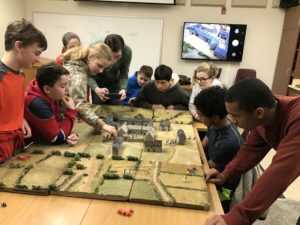
Using artistic model-making techniques, hand tools, and historical maps, students will each form a 10" X 14" shaped, foam diorama with landscape elements (hills, valleys, rivers, ridges, vegetation, airfields, etc) to represent a scene of a famous historical engagement. Students will each receive scale miniature naval ships to populate their scene. Once individual projects are constructed, students will combine their dioramas alongside those of their classmates to approximate the larger battlefield terrain. Students will spend the remainder of the quarter learning about the tactics and outcomes of the military engagement while playing a table-top strategy game. Student strategists will use a simplified version of the Axis and Allies gaming rule system for moving troops and equipment. Along with their classmates, students will see how this battle progressed and test different outcome scenarios that might have occurred with different battlefield choices.
The instructor will use maps and visual presentations to explain the historical background and circumstances leading up to the specific battle. Course documents, such as period maps, game rules and all other instructional media will be available via a Google Drive link which will be emailed to parents. There is a $25.00 materials fee payable to the instructor on the first day of class.
Topics in this year's series include: Pearl Harbor (Quarter 1), Guadalcanal (Quarter 2), D-Day (Quarter 3), and Battle of the Bulge (Quarter 4).
Battle Strategies & Dioramas: WWII- Guadalcanal (WED)
Quarter 2: Starts on October 28, 2026
Class Time: 2:00 pm Duration: 55 min
Instructor: Taliesin Knol
Grade Range: 6th-8th
Prerequisites:
Take command of the battlefield as you design and deploy your own 3D military diorama. After early defeats across the Pacific, the United States halted Japanese expansion at Midway and carried the fight to Guadalcanal in the Solomon Islands. What followed was a grueling campaign on land and sea, where control of a single airfield could determine the fate of the entire region. This class examines the brutal island fighting and the repeated naval battles at Iron Bottom Sound that marked the beginning of the Allied offensive.
Using artistic model-making techniques, hand tools, and historical maps, students will each form a 10" X 14" shaped, foam diorama with landscape elements (hills, valleys, rivers, ridges, vegetation, airfields, etc) to represent a scene of a famous historical engagement. Students will each receive scale miniature naval ships to populate their scene. Once individual projects are constructed, students will combine their dioramas alongside those of their classmates to approximate the larger battlefield terrain. Students will spend the remainder of the quarter learning about the tactics and outcomes of the military engagement while playing a table-top strategy game. Student strategists will use a simplified version of the Axis and Allies gaming rule system for moving troops and equipment. Along with their classmates, students will see how this battle progressed and test different outcome scenarios that might have occurred with different battlefield choices.
The instructor will use maps and visual presentations to explain the historical background and circumstances leading up to the specific battle. Course documents, such as period maps, game rules and all other instructional media will be available via a Google Drive link which will be emailed to parents. There is a $25.00 materials fee payable to the instructor on the first day of class.
Topics in this year's series include: Pearl Harbor (Quarter 1), Guadalcanal (Quarter 2), D-Day (Quarter 3), and Battle of the Bulge (Quarter 4).
Beginner 'Bots: Wings and Things (THU)
Quarter 2: Starts on October 29, 2026
Class Time: 11:00 am Duration: 55 min
Instructor: Becca Sticha
Grade Range: 3rd-4th
Prerequisites:
Discover the world of robotics using kids' favorite, interlocking building bricks! Students will build and program 3-4 different whimsical, mechanized projects each quarter using the WeDo 2.0 robotics system by LEGO Education.
Second quarter, students will build, program, and model fun and fantasy flying fliers wonders such as a helicopter, plane, a mythical bird, and a winged dragon.
Their robots will be built using special-shaped LEGO components from the WeDo Educational set, motors, motion sensors, tilt sensors and a programmable, Bluetooth control unit ("brain"). Student will use classroom tablets to program the control units using an intuitive drag-and-drop coding modules.
Prior experience with LEGO or coding is not required. All equipment is furnished.
Topics in this Series: Under the Sea (Quarter 1), Wings and Things (Quarter 2); Perfect Pets (Quarter 3), and Reptiles Robots (Quarter 4).
Beginner 'Bots: Wings and Things (TUE)
Quarter 2: Starts on October 27, 2026
Class Time: 1:00 pm Duration: 55 min
Instructor: Becca Sticha
Grade Range: 3rd-4th
Prerequisites:
Discover the world of robotics using kids' favorite, interlocking building bricks! Students will build and program 3-4 different whimsical, mechanized projects each quarter using the WeDo 2.0 robotics system by LEGO Education.
Second quarter, students will build, program, and model fun and fantasy flying fliers wonders such as a helicopter, plane, a mythical bird, and a winged dragon.
Their robots will be built using special-shaped LEGO components from the WeDo Educational set, motors, motion sensors, tilt sensors and a programmable, Bluetooth control unit ("brain"). Student will use classroom tablets to program the control units using an intuitive drag-and-drop coding modules.
Prior experience with LEGO or coding is not required. All equipment is furnished.
Topics in this Series: Under the Sea (Quarter 1), Wings and Things (Quarter 2); Perfect Pets (Quarter 3), and Reptiles Robots (Quarter 4).
Best Books for Boys: Courage
Quarter 2: Starts on October 29, 2026
Class Time: 12:00 pm Duration: 55 min
Instructor: Dr. Anneca Robinson
Grade Range: 5th-6th
Prerequisites:
Best Books for Boys is a book club just for preteen boys. Each quarter, students read one standout novel and spend class time going deeper. Boys act out scenes, debate what characters should have done differently, write sequel pitches or alternate endings, and explore the real-world connections behind the story. Through conversation and guided activities, students begin to read more closely, noticing how authors develop characters, build suspense, and make deliberate choices about how a story unfolds.
Each quarter, one book is the teacher's selection and a second book is chosen by the class from a short, approved list. Students read assigned chapters at home and come to class prepared to share their reflections and discuss the books. All books are selected from Newbery Medalists and Honor Books, Caldecott Medal titles, Parents' Choice Award winners, and proven classics of children's fiction.
.
This year's themes and teacher's choice books: Quarter 1: Ingenuity (The First State of Being by Erin Entrada Kelly, 2025 Newbery Medal); Quarter 2: Courage (Freewater by Amina Luqman-Dawson, 2024 Newbery Medal); Quarter 3: Determination (When You Reach Me by Rebecca Stead, 2010 Newbery Medal); and Quarter 4: Curiosity (The Eyes and the Impossible by Dave Eggers, 2024 Newbery Medal).
Level: This class is designed for 5th and 6th graders. 4th grade students reading above grade level are welcome.
Novels: The cost of a new, mass-market paperback edition of the first book title is included in the class tuition. Parents are responsible for buying or borrowing a copy of the second book from the library, once selected.
What to Bring: Current novel, paper, pen or pencil, and a highlighter. Sticky notes or adhesive flags are helpful for marking key moments.
Biome Builders- Marshlands
Quarter 2: Starts on October 27, 2026
Class Time: 2:00 pm Duration: 55 min
Instructor: Taliesin Knol
Grade Range: 3rd-5th
Prerequisites: Minimum age 8
The best way to understand a biome is to build (a model) one! A biome is a large zone on Earth characterized by its climate, soil, vegetation, and organisms with special adaptations for the unique environment. In modeling biomes, students will learn how they are different than similar ecological concepts like habitats and ecosystems. Students will discover how human activities, such as deforestation and habitat destruction, are transforming biomes.
In this science-themed diorama class, students will be exposed to concepts such as trophic levels, the water cycle, biological competition, geographic isolation, convergent evolution, species diversification, natural vs unnatural climate change, food webs, habitat loss, and ecological niches, while they are working on their models.
Marshlands are dynamic ecosystems found along the edges of lakes, rivers, and coastlines. They are distinguished by their waterlogged soils, which support the growth of diverse, soft-stemmed vegetation such as grasses, rushes, and reeds. These plants play a critical role in stabilizing the shore, filtering water, and providing habitat and food sources for a diverse population of birds, amphibians, insects, and small mammals.
Each student will create an individual diorama. Students will craft and hand-shape their scene on a 10 x 14 inch foam board using artistic, model-making techniques. They will customize their dioramas with landforms, waterways, plant life, and paint. Once individual projects are constructed, students will populate them with miniature figures and combine their dioramas alongside those of their classmates to create a larger terrain. Students will then compete in a zoology-based survival strategy game. Each student will create one board and receive a set of miniatures to take home with them. Course documents such as maps, game rules and all other instructional media will be available via a Google Drive link which will be emailed to parents. There is a $25.00 materials fee payable to the instructor on the first day of class.
Topics in this series include: Mangrove Swamps (Quarter 1), Marshlands (Quarter 2), Coral Reefs (Quarter 3) and Deep Sea Trenches (Quarter 4).
BoxFit for Teens- Orange
Quarter 2: Starts on October 30, 2026
Class Time: 12:00 pm Duration: 55 min
Instructor: Iman Castaneda
Grade Range: 9th-12th
Prerequisites:
This boxing fundamentals class helps teens build coordination, confidence, and controlled athletic movement in a safe and structured environment.
Students will learn proper boxing stance and footwork, practice space awareness and movement control, and develop correct punching mechanics through guided drills. Conditioning exercises will improve balance, focus, and overall fitness while building strength and endurance.
All power punches are directed only at heavy bag- never at another student. Students will practice shadow sparring, a non-contact drill that focuses on movement, timing, and technique rather than striking an opponent.
Safety is a top priority. There will be no head contact, no hard punches to the body, and no student-to-student striking of any kind. The class emphasizes discipline, self-control, and skill development rather than aggression.
BoxFit for Teens offers a positive outlet for energy while helping students improve coordination, fitness, and confidence in a supportive, supervised setting.
The color name in the class title refers to the collectable token students will earn each quarter they take the class. Collect all 8! Teens may enroll in Total Training at any time, regardless of the color name No one color is a prerequisite for any other color, and tokens can be earned in any order.
All equipment is furnished. Students are asked to wear loose, comfortable clothing, such as running pants or sweatpants, and comfortable, supportive athletic shoes. BoxFit continues each quarter, and students may repeat the class to continue to improve fitness. No two workouts are the same!
Build Zone! Construction Lab (THU, Q2)
Quarter 2: Starts on October 29, 2026
Class Time: 3:00 pm Duration: 55 min
Instructor: Compass Homeschool Program
Grade Range: 2nd-6th
Prerequisites: None
Enter the BuildZone and step into a world of endless possibilities, where over 10,000 building components are at your fingertips! From Keva Planks to K'Nex, Magnatiles to Marble Runs, Tubelox, Chaos Tower, and Pipe Builders-this is the ultimate mash-up of all things construction.
Here, you're the architect, the engineer, the mastermind. Stack it, snap it, connect it- then remix it! What happens when you combine pieces from totally different sets? You get taller towers, stronger structures, and mind-blowing mega builds! Build solo masterpieces or team up for cool collaborations. Every session is a chance to dream big, build bigger, and let your imagination break all the rules.
This is a hands-on afternoon lab intended to provide opportunities for kids to socialize and tap into their creative energy in a relaxed club setting. No formal curriculum or lessons are provided. This is a supervised free-build session. All participants are expected to help pick up and to follow all Compass rules on indoor behavior including respecting materials, supplies, and furnishings.
Build Zone! Construction Lab (TUE, Q2)
Quarter 2: Starts on October 27, 2026
Class Time: 3:00 pm Duration: 55 min
Instructor: Compass Homeschool Program
Grade Range: 2nd-6th
Prerequisites: None
Enter the BuildZone and step into a world of endless possibilities, where over 10,000 building components are at your fingertips! From Keva Planks to K'Nex, Magnatiles to Marble Runs, Tubelox, Chaos Tower, and Pipe Builders-this is the ultimate mash-up of all things construction.
Here, you're the architect, the engineer, the mastermind. Stack it, snap it, connect it- then remix it! What happens when you combine pieces from totally different sets? You get taller towers, stronger structures, and mind-blowing mega builds! Build solo masterpieces or team up for cool collaborations. Every session is a chance to dream big, build bigger, and let your imagination break all the rules.
This is a hands-on afternoon lab intended to provide opportunities for kids to socialize and tap into their creative energy in a relaxed club setting. No formal curriculum or lessons are provided. This is a supervised free-build session. All participants are expected to help pick up and to follow all Compass rules on indoor behavior including respecting materials, supplies, and furnishings.
Build Zone! Construction Lab (WED, Q2)
Quarter 2: Starts on October 28, 2026
Class Time: 3:00 pm Duration: 55 min
Instructor: Compass Homeschool Program
Grade Range: 2nd-6th
Prerequisites: None
Enter the BuildZone and step into a world of endless possibilities, where over 10,000 building components are at your fingertips! From Keva Planks to K'Nex, Magnatiles to Marble Runs, Tubelox, Chaos Tower, and Pipe Builders-this is the ultimate mash-up of all things construction.
Here, you're the architect, the engineer, the mastermind. Stack it, snap it, connect it- then remix it! What happens when you combine pieces from totally different sets? You get taller towers, stronger structures, and mind-blowing mega builds! Build solo masterpieces or team up for cool collaborations. Every session is a chance to dream big, build bigger, and let your imagination break all the rules.
This is a hands-on afternoon lab intended to provide opportunities for kids to socialize and tap into their creative energy in a relaxed club setting. No formal curriculum or lessons are provided. This is a supervised free-build session. All participants are expected to help pick up and to follow all Compass rules on indoor behavior including respecting materials, supplies, and furnishings.
Chef's Special: Christmas Cookie Academy- Kids/Tweens
Quarter 2: Starts on December 11, 2026
Class Time: 1:00 pm Duration: 180 min
Instructor: Mylene Nyman
Grade Range: 5th-8th
Prerequisites:
Chewy, chunky, crispy, or crunchy- kids love cookies! Join us for a one-day, 3-hour Christmas Cookie Academy where bakers will craft 3 kinds of cookies. In the workshop, kids will prepare and bake: Spiced Sugar Cookies with Espresso Glaze, Spritz Butter Cookies, Orange Cranberry Cookies with Orange Glaze, and White Chocolate Cherry Oat. Students will leave with a tray of 3-4 dozen cookies ready for an exchange or holiday party and the recipes to repeat the cookies at home. See the Compass Cooking Class webpage for more FAQs about our cooking classes. There is a supply fee of $25.00 due to the instructor on/before the start of the workshop.
Chef's Special: Christmas Cookie Academy- Little Kids
Quarter 2: Starts on December 11, 2026
Class Time: 10:00 am Duration: 180 min
Instructor: Mylene Nyman
Grade Range: 1st-4th
Prerequisites:
Chewy, chunky, crispy, or crunchy- kids love cookies! Join us for a one-day, 3-hour Christmas Cookie Academy where bakers will craft 3 kinds of cookies. In the workshop, kids will prepare and bake: Spritz Butter Cookies, Orange Cranberry Cookies with Orange Glaze, and White Chocolate Cherry Oat. Students will leave with a tray of 3-4 dozen cookies ready for an exchange or holiday party and the recipes to repeat the cookies at home. See the Compass Cooking Class webpage for more FAQs about our cooking classes. There is a supply fee of $25.00 due to the instructor on/before the start of the workshop.
Chef's Special: Deck-the-House Gingerbread Workshop
Quarter 2: Starts on December 4, 2026
Class Time: 10:00 am Duration: 180 min
Instructor: Mylene Nyman
Grade Range: K-5th
Prerequisites:
Candy-cane columns, licorice lattice, gumdrop gutters, iced icicles, or a peppermint path. Journey to your own Candyland with darling gingerbread houses adorned with unique confection constructions. Enjoy your gingerbread house as a holiday centerpiece or a delicious pull-apart treat! Students will learn how to plan their design considering layout and symmetry. Then they will learn how to embellish with Royal icing and candy-encrusted details. They will also learn how to simulate frosted shingles and how to do chocolate writing. The instructor will provide a mouth-watering array of candy decor choices.
Notes: (1) For children under age 8, an adult must attend with the child. Over age 8, children may be dropped (2) Some garnishes (gummies or marshmallows) may contain gelatin and food coloring. (3) Each student should bring a cookie sheet to transport his/her gingerbread house home. (4) There is a supply fee of $25.00 due to the instructor on/before start of the workshop.
Chef's Special: Eating Through History- Medieval Fare
Quarter 2: Starts on November 6, 2026
Class Time: 10:00 am Duration: 180 min
Instructor: Mylene Nyman
Grade Range: 5th-8th
Prerequisites:
Step into the past. Cook from centuries ago. In Eating Through History: Medieval Fare, students explore the foods and traditions of medieval England through hands-on cooking and engaging discussion. Each week, students prepare recipes inspired by historical sources while learning how food reflected daily life, social structure, and available ingredients. Students will make:
- Spiced gingerbread (England, 14th-century)
- Douce Zane, a savory-sweet dish of capon (chicken) with milk and honey (England, 1390)
- Pumpion Pie (England, 1670)
This immersive class blends culinary skills with cultural exploration, helping students experience history in a way they can see, smell, and taste. See the Compass Cooking Class webpage for more FAQs about our cooking classes. There is a supply fee of $25.00 due to the instructor on/before the start of the workshop.
Chef's Special: Kids' Own Thanksgiving
Quarter 2: Starts on November 20, 2026
Class Time: 10:00 am Duration: 180 min
Instructor: Mylene Nyman
Grade Range: 5th-8th
Prerequisites:
Warm ovens. Wonderful aromas. A table made more meaningful by their own hands. In Kids' Own Thanksgiving, young cooks step into the heart of the holiday by preparing delicious, crowd-pleasing dishes to share with their families. This hands-on workshop celebrates the joy of giving, as students create recipes they can proudly contribute to the Thanksgiving table.
Students will prepare a selection of festive favorites with a creative twist including:
- Spinach Stuffing Balls
- Victorian Sugared Cranberries
- Tomato Manchego Tartlets
- Apricot and Prosciutto Focaccia
Along the way, they will build confidence in the kitchen while learning techniques that bring both flavor and presentation to life.
Each dish is designed to be taken home and either frozen and reheated on Thanksgiving Day or recreated and perfected for the big meal. Whether served as a side, appetizer, or showpiece, these recipes allow students to take an active role in their family's celebration and experience the true joy of sharing what they've made. There is a $25.00 supply fee due payable to the instructor on/before the start of the workshop.
Chemist Kids: Chemistry in Action
Quarter 2: Starts on October 28, 2026
Class Time: 11:00 am Duration: 55 min
Instructor: Michele Forsythe
Grade Range: 3rd-4th
Prerequisites:
Kids are naturally curious about chemistry! Chemistry explains the properties, behaviors, and interactions of materials around us: things we eat, drink, clean with, wear, drive, and even play with. Kids can use chemistry to understand how things taste, smell, mix, melt, combust, feel, and whether they are recyclable or rubbish, helpful or harmful, nutritious or not. Chemistry is key to understanding the world around us, including other areas of science. In this class, kids begin to use scientific words to describe their observations and will become familiar with some science apparatuses.
Second quarter, kids will discover chemistry in action and in industry. They will grow great crystals and test how to treat tarnished metal. Our chemists will discover how cabbage juice can be used to check for acids and bases. They will discover how to melt ice with salt and how to remove salt from solution (desalinization). Students will make simple cell batteries to power a small light bulb. What shines brighter- a potato or a pomelo- and why? The class will learn to use basic chemistry to do copper plating and explore the properties of paint.
There is a lab fee of $25.00 due payable to the instructor on/before the first day of class. Topics in this series include: Chemistry in the Kitchen (Quarter 1), Chemistry in Action (Quarter 2), Chemistry at Home (Quarter 3), and Chemistry of Toys (Quarter 4).
Chess for Teens: All-Level (Q2)
Quarter 2: Starts on October 30, 2026
Class Time: 2:00 pm Duration: 55 min
Instructor: Grand Master Babaev
Grade Range: 8th-12th
Prerequisites:
Teens will enjoy the logic and challenge of the timeless strategy board game as they learn and play chess with classmates. This is a multi-level class open to Beginners, Advanced Beginners, or Intermediate Players. Instruction will be differentiated based on the make-up of the class, and teens will be placed in pairs or groups depending on experience. Each session will be with some time dedicated to a lesson and some time reserved for in-class matches that are monitored and supported by the coach. Beginners may play as a group against the instructor which is a low-pressure way to learn the game. Teens who are engrossed in their games may continue their play into Friday Teen Game Night.
Learning and playing chess supports problem solving, decision making, critical and creative thinking, general cognitive ability, scholastic skills, and mathematical achievement (Univ. of Minnesota). Experts suggest that the game of chess teaches analytical and disciplined thinking skills, while raising self esteem, teaching motivation and determination, and sportsmanship (Kasparov Foundation).
Credit: Homeschool families may wish to count this course as a component (partial) credit in logic/reasoning or and elective for purposes of a high school transcript.
Chess- Advanced Beginner 2 (Thu)
Quarter 2: Starts on October 29, 2026
Class Time: 11:00 am Duration: 55 min
Instructor: Oladapo Adu
Grade Range: 3rd-6th
Prerequisites: Beginner Chess
Two armies. One battlefield. Infinite possibilities.
Across a checkered board, two mighty monarchies prepare for battle. In this legendary clash of kings and queens, which side will triumph in a test of wit, patience, perseverance, and strategy? Students will explore the logic and thrill of the timeless game of chess under the expert guidance of an International Chess Master. Whether you're a budding tactician or a curious beginner, prepare to sharpen your mind and rise to the challenge.
In Advanced Beginning Chess, students will use the Explorers Level curriculum developed by Grandmaster Babaev for his GMChessPrep program. During Quarter 2, the focus will be on opening principles, positional play, and advanced endgames. The class will learn how to start the chess game considering basic piece development, control of the center, castling early and king safety. Students will continue to learn endgame scenarios such as King + Pawn vs. King and promotion techniques, the Passed Pawn, the Rule of the Square, and vertical opposition. Finally, the class will be introduced to mini games with quick mates and traps such as Scholar's Mate, Fool's Mate, and F7 attacks.
Learning and playing chess promote problem solving, decision making, critical and creative thinking, general cognitive ability, scholastic skills, and mathematical achievement (Univ. of Minnesota). Experts suggest that the game of chess teaches analytical and disciplined thinking skills, while raising self esteem, teaching motivation and determination, and sportsmanship (Kasparov Foundation). Each class will be spent part on instruction and part on playing time in practice matches with classmates while the instructor gives tips and reminders.
Compass chess students will be given access to GMChessPrep's online portal for virtual chess practice opportunities between classes. Also, students who are absent can request a make-up session during a regularly scheduled GMC online evening group class.
Chess- Advanced Beginner 2 (Wed)
Quarter 2: Starts on October 28, 2026
Class Time: 11:00 am Duration: 55 min
Instructor: Oladapo Adu
Grade Range: 3rd-6th
Prerequisites: Beginner Chess
Two armies. One battlefield. Infinite possibilities.
Across a checkered board, two mighty monarchies prepare for battle. In this legendary clash of kings and queens, which side will triumph in a test of wit, patience, perseverance, and strategy? Students will explore the logic and thrill of the timeless game of chess under the expert guidance of an International Chess Master. Whether you're a budding tactician or a curious beginner, prepare to sharpen your mind and rise to the challenge.
In Advanced Beginning Chess, students will use the Explorers Level curriculum developed by Grandmaster Babaev for his GMChessPrep program. During Quarter 2, the focus will be on opening principles, positional play, and advanced endgames. The class will learn how to start the chess game considering basic piece development, control of the center, castling early and king safety. Students will continue to learn endgame scenarios such as King + Pawn vs. King and promotion techniques, the Passed Pawn, the Rule of the Square, and vertical opposition. Finally, the class will be introduced to mini games with quick mates and traps such as Scholar's Mate, Fool's Mate, and F7 attacks.
Learning and playing chess promote problem solving, decision making, critical and creative thinking, general cognitive ability, scholastic skills, and mathematical achievement (Univ. of Minnesota). Experts suggest that the game of chess teaches analytical and disciplined thinking skills, while raising self esteem, teaching motivation and determination, and sportsmanship (Kasparov Foundation). Each class will be spent part on instruction and part on playing time in practice matches with classmates while the instructor gives tips and reminders.
Compass chess students will be given access to GMChessPrep's online portal for virtual chess practice opportunities between classes. Also, students who are absent can request a make-up session during a regularly scheduled GMC online evening group class.
Chess- Advanced Intermediate 2
Quarter 2: Starts on October 29, 2026
Class Time: 10:00 am Duration: 55 min
Instructor: Oladapo Adu
Grade Range: 5th-8th
Prerequisites: Intermediate Chess
Two armies. One battlefield. Infinite possibilities.
Across a checkered board, two mighty monarchies prepare for battle. In this legendary clash of kings and queens, which side will triumph in a test of wit, patience, perseverance, and strategy? Students will explore the logic and thrill of the timeless game of chess under the expert guidance of an International Chess Master. Whether you're a budding tactician or a curious beginner, prepare to sharpen your mind and rise to the challenge.
Advanced Intermediate Chess is for students with 3+ years experience playing chess and an interest in preparing for competitive play. Second quarter will focus on opening repertoire, strategic identity, and "deep middle games" through the examination of great champions, advanced endgame theory, and classical game mastery. The group will learn about advanced opening concepts such as positional sacrifices, move-order nuances, transpositions, and defensive setups. The class will also learn about building an opening repertoire and tactical, strategic, or hybrid style, and using chess engines + databases to explore novelty. They will learn patterns and board geometry through Taimanov's Knight Check, the Rh-Nf7 trick, and Morphy's and Pillsbury's Mates.
Learning and playing chess promote problem solving, decision making, critical and creative thinking, general cognitive ability, scholastic skills, and mathematical achievement (Univ. of Minnesota). Experts suggest that the game of chess teaches analytical and disciplined thinking skills, while raising self esteem, teaching motivation and determination, and sportsmanship (Kasparov Foundation). Each class will be spent part on instruction and part on playing time in practice matches with classmates while the instructor gives tips and reminders.
Compass chess students will be given access to GMChessPrep's online portal for virtual chess practice opportunities between classes. Also, students who are absent can request a make-up session during a regularly scheduled GMC online evening group class.
Chess- Beginner 2 (Thu)
Quarter 2: Starts on October 29, 2026
Class Time: 12:00 pm Duration: 55 min
Instructor: Oladapo Adu
Grade Range: 2nd-5th
Prerequisites:
Two armies. One battlefield. Infinite possibilities.
Across a checkered board, two mighty monarchies prepare for battle. In this legendary clash of kings and queens, which side will triumph in a test of wit, patience, perseverance, and strategy? Students will explore the logic and thrill of the timeless game of chess under the expert guidance of an International Chess Master. Whether you're a budding tactician or a curious beginner, prepare to sharpen your mind and rise to the challenge.
In Beginning Chess, students will use the Foundation Level curriculum developed by Grandmaster Babaev for his GMChessPrep program. During Quarter 2, the goal is to increase understanding of how all chess pieces move and learn the core structure of gameplay. Students will meet the knights, bishops, rooks and the queen, learning the movements and rules for each. The class will also learn some special moves such as castling, pawn promotion, and en passant. Their in-class mini games will practice king vs. king and pawn strategies; knight-capture games, and 4X4 and 6X6 training exercises.
Learning and playing chess promote problem solving, decision making, critical and creative thinking, general cognitive ability, scholastic skills, and mathematical achievement (Univ. of Minnesota). Experts suggest that the game of chess teaches analytical and disciplined thinking skills, while raising self-esteem, teaching motivation and determination, and sportsmanship (Kasparov Foundation). Each class will be spent part on instruction and part on playing time in practice matches with classmates while the instructor gives tips and reminders.
Compass chess students will be given access to GMChessPrep's online portal for virtual chess practice opportunities between classes. Also, students who are absent can request a make-up session during a regularly scheduled GMC online evening group class.
Chess- Beginner 2 (Wed)
Quarter 2: Starts on October 28, 2026
Class Time: 10:00 am Duration: 55 min
Instructor: Oladapo Adu
Grade Range: 2nd-5th
Prerequisites:
Two armies. One battlefield. Infinite possibilities.
Across a checkered board, two mighty monarchies prepare for battle. In this legendary clash of kings and queens, which side will triumph in a test of wit, patience, perseverance, and strategy? Students will explore the logic and thrill of the timeless game of chess under the expert guidance of an International Chess Master. Whether you're a budding tactician or a curious beginner, prepare to sharpen your mind and rise to the challenge.
In Beginning Chess, students will use the Foundation Level curriculum developed by Grandmaster Babaev for his GMChessPrep program. During Quarter 2, the goal is to increase understanding of how all chess pieces move and learn the core structure of gameplay. Students will meet the knights, bishops, rooks and the queen, learning the movements and rules for each. The class will also learn some special moves such as castling, pawn promotion, and en passant. Their in-class mini games will practice king vs. king and pawn strategies; knight-capture games, and 4X4 and 6X6 training exercises.
Learning and playing chess promote problem solving, decision making, critical and creative thinking, general cognitive ability, scholastic skills, and mathematical achievement (Univ. of Minnesota). Experts suggest that the game of chess teaches analytical and disciplined thinking skills, while raising self-esteem, teaching motivation and determination, and sportsmanship (Kasparov Foundation). Each class will be spent part on instruction and part on playing time in practice matches with classmates while the instructor gives tips and reminders.
Compass chess students will be given access to GMChessPrep's online portal for virtual chess practice opportunities between classes. Also, students who are absent can request a make-up session during a regularly scheduled GMC online evening group class.
Chess- Intermediate 2
Quarter 2: Starts on October 28, 2026
Class Time: 12:00 pm Duration: 55 min
Instructor: Oladapo Adu
Grade Range: 4th-7th
Prerequisites: Advanced Beginner Chess
Two armies. One battlefield. Infinite possibilities.
Across a checkered board, two mighty monarchies prepare for battle. In this legendary clash of kings and queens, which side will triumph in a test of wit, patience, perseverance, and strategy? Students will explore the logic and thrill of the timeless game of chess under the expert guidance of an International Chess Master. Whether you're a budding tactician or a curious beginner, prepare to sharpen your mind and rise to the challenge.
In Intermediate Chess, students will use the Strategists Level curriculum developed by Grandmaster Babaev for his GMChessPrep program. During Quarter 2, the focus will be on pawn dynamics, practical endgames, and board control. The group will continue an examination of endgame strategies including: double pawns, triple pawns, passed pawns, and protected-pass pawns. The class will evaluate mating patterns such as Weak Dark Squares, Lolli's Mate, Pawn on 7th, and Queen-Bishop set-up. They will cover basic opening principles like control of the center, piece development, and king safety, and opening names like Italian, Scotch, and brief introduction to Four Knights. Students will work visual examples, play practice positions, learn to identify and evaluate value and weakness through visual examples, and puzzle practice.
Learning and playing chess promote problem solving, decision making, critical and creative thinking, general cognitive ability, scholastic skills, and mathematical achievement (Univ. of Minnesota). Experts suggest that the game of chess teaches analytical and disciplined thinking skills, while raising self-esteem, teaching motivation and determination, and sportsmanship (Kasparov Foundation). Each class will be spent part on instruction and part on playing time in practice matches with classmates while the instructor gives tips and reminders.
Compass chess students will be given access to GMChessPrep's online portal for virtual chess practice opportunities between classes. Also, students who are absent can request a make-up session during a regularly scheduled GMC online evening group class.
Colorful Canvas for Kids: Acrylic Painting
Quarter 2: Starts on October 29, 2026
Class Time: 2:00 pm Duration: 55 min
Instructor: Natalia Malley
Grade Range: 2nd-4th
Prerequisites:
Ready to show your true colors? Grab a brush, dive into dazzling paints and let bold brushstrokes, brilliant blends, and boundless creativity spill across the canvas. In Colorful Canvas, every artist brings their imagination to life- one vibrant masterpiece at a time.
Discover the bold possibilities of acrylic paint as students develop their skills through vibrant color, versatile techniques, and detailed composition. In this class, artists will practice color mixing, blending, layering, and building strong compositions. They will experiment with different brush techniques to create texture, movement, light, and shadow, while learning how to bring their ideas to life on canvas.
Students will complete several paintings on canvas boards inspired by a variety of themes, including animals, landscapes, fantasy, still life, and abstract art, along with fun projects inspired by famous artists.
There is a $20.00 supply fee due payable to the instructor on/before the first day of class. Topics in this series include: Tempera Painting (Quarter 1), Acrylic Painting (Quarter 2), Multimedia Painting (Quarter 3), and Watercolor Painting (Quarter 4).
Colorful Canvas for Teens: Acrylic Painting
Quarter 2: Starts on October 29, 2026
Class Time: 1:00 pm Duration: 55 min
Instructor: Natalia Malley
Grade Range: 7th-8th
Prerequisites:
Ready to show your true colors? Grab a brush, dive into dazzling paints and let bold brushstrokes, brilliant blends, and boundless creativity spill across the canvas. In Colorful Canvas, every artist brings their imagination to life- one vibrant masterpiece at a time.
Discover the bold possibilities of acrylic paint as students develop their skills through vibrant color, versatile techniques, and detailed composition. In this class, artists will practice color mixing, blending, layering, and building strong compositions. They will experiment with different brush techniques to create texture, movement, light, and shadow, while learning how to bring their ideas to life on canvas.
Students will complete several paintings on canvas boards inspired by a variety of themes, including animals, landscapes, fantasy, still life, and abstract art, along with fun projects inspired by famous artists.
There is a $20.00 supply fee due payable to the instructor on/before the first day of class. Topics in this series include: Tempera Painting (Quarter 1), Acrylic Painting (Quarter 2), Multimedia Painting (Quarter 3), and Watercolor Painting (Quarter 4).
Colorful Canvas for Tweens: Acrylic Painting
Quarter 2: Starts on October 29, 2026
Class Time: 12:00 pm Duration: 55 min
Instructor: Natalia Malley
Grade Range: 5th-6th
Prerequisites:
Ready to show your true colors? Grab a brush, dive into dazzling paints and let bold brushstrokes, brilliant blends, and boundless creativity spill across the canvas. In Colorful Canvas, every artist brings their imagination to life- one vibrant masterpiece at a time.
Discover the bold possibilities of acrylic paint as students develop their skills through vibrant color, versatile techniques, and detailed composition. In this class, artists will practice color mixing, blending, layering, and building strong compositions. They will experiment with different brush techniques to create texture, movement, light, and shadow, while learning how to bring their ideas to life on canvas.
Students will complete several paintings on canvas boards inspired by a variety of themes, including animals, landscapes, fantasy, still life, and abstract art, along with fun projects inspired by famous artists.
There is a $20.00 supply fee due payable to the instructor on/before the first day of class. Topics in this series include: Tempera Painting (Quarter 1), Acrylic Painting (Quarter 2), Multimedia Painting (Quarter 3), and Watercolor Painting (Quarter 4).
Compass 2 College: Foundations
Quarter 1,2,3,4: Starts on June 1, 2026
Class Time: 9:00 am
Grade Range: 9th-10th
Compass 2 College: Foundations helps high school families of 9th and 10th graders get organized early with college planning, transcripts, GPA calculation, course records, testing options, and advising. Students receive two advising meetings each year, priority access to PSAT preparation workshops, the opportunity to apply for Compass-exclusive internships, and guidance on service, leadership, and student awards. The goal is to help families build a strong, well-documented high school record without waiting until senior year. Read more about Compass 2 College.
Compass 2 College: Scholars
Quarter 1,2,3,4: Starts on June 1, 2026
Class Time: 9:00 am
Grade Range: 11th-12th
Compass 2 College: Scholars provides expanded college-planning support for high school students who want more guidance as they prepare for applications, essays, transcripts, testing, and senior-year milestones. Scholars students receive two annual advising meetings, transcript and GPA support, priority access to SAT preparation and college essay-writing workshops, access to Compass-exclusive internship opportunities, and guidance on service, leadership, awards, and Common App homeschool counselor responses. Senior Scholars may also choose a professional diploma and graduation regalia options for Compass’s graduation or another ceremony. Read more about Compass 2 College.
Compass Crochet Club (TUE, Q2)
Quarter 2: Starts on October 27, 2026
Class Time: 3:00 pm Duration: 55 min
Instructor: Mylene Nyman
Grade Range: 4th-Adult
Prerequisites:
Welcome to the Compass Crochet Club- where creativity loops us together! Kids, tweens, and teens enjoy crochet because it's relaxing, hands-on, and lets them turn yarn into something uniquely their own. Whether they're stitching up scrunchies or crafting colorful creatures, it's even more fun when shared with friends in relaxing afternoon club.
For new beginners, Crochet Club is run as a facilitated, quarter long workshop that teaches the fundamentals needed to get crafting. Second quarter, beginners will select from two projects: a big, bulky scarf using the single crochet and chain stitches plus a fringe stitch OR, a holiday garland that uses the Bubble Stitch to look like popcorn and cranberries.
New students are welcome to join the club at any point during the year and will begin with foundational stitches and starter projects. Intermediate and advanced crocheters are encouraged to refine their skills, share tips and techniques, and serve as peer role models for newer members. More experienced participants may bring their own works in progress or contribute to meaningful service projects, such as crocheting NICU infant hats, caps for the homeless, or blankets for Project Linus. Parents are welcome to join the club and may register to learn and crochet alongside their children.
There is a $30.00 supply fee is due payable to the instructor on/before the first week of the club.
Note: This is a 6-week club.
Compass Crochet Club (WED, Q2)
Quarter 2: Starts on October 28, 2026
Class Time: 3:00 pm Duration: 55 min
Instructor: Mylene Nyman
Grade Range: 4th-Adult
Prerequisites:
Welcome to the Compass Crochet Club- where creativity loops us together! Kids, tweens, and teens enjoy crochet because it's relaxing, hands-on, and lets them turn yarn into something uniquely their own. Whether they're stitching up scrunchies or crafting colorful creatures, it's even more fun when shared with friends in relaxing afternoon club.
For new beginners, Crochet Club is run as a facilitated, quarter long workshop that teaches the fundamentals needed to get crafting. Second quarter, beginners will select from two projects: a big, bulky scarf using the single crochet and chain stitches plus a fringe stitch OR, a holiday garland that uses the Bubble Stitch to look like popcorn and cranberries.
New students are welcome to join the club at any point during the year and will begin with foundational stitches and starter projects. Intermediate and advanced crocheters are encouraged to refine their skills, share tips and techniques, and serve as peer role models for newer members. More experienced participants may bring their own works in progress or contribute to meaningful service projects, such as crocheting NICU infant hats, caps for the homeless, or blankets for Project Linus. Parents are welcome to join the club and may register to learn and crochet alongside their children.
There is a $30.00 supply fee is due payable to the instructor on/before the first week of the club.
Note: This is a 6-week club.
Compass Kids' Chorus: Classic Chorals
Quarter 2: Starts on October 27, 2026
Class Time: 10:00 am Duration: 55 min
Instructor: Dr. Alina Kirshon-Goldman
Grade Range: 3rd-5th
Prerequisites:
Everyone can learn to sing! This quarter, children will sing classics that shine such as "Somewhere Over the Rainbow" from The Wizard of Oz,
"Edelweiss" from The Sound of Music, "What a Wonderful World" by Louis Armstrong, or "Lean on Me" by Bill Withers. Once the group is formed and their musicality is evaluated, the instructor will offer a selection of pieces tailored to the ensemble.
The quarter's repertoire will include at least one group choral number. Students will work on other music as solos, duets, or small group numbers. This introduction to vocal development and performance includes posture, breathing, intonation, and the principles of blending vocal harmonies. Basic musical notation will be introduced as well as melodic and harmonic intervals. No previous musical experience is required- just the joy of singing! Singers will be expected to memorize pieces and participate in a showcase for parents at the end of the quarter.
Topics in this series include: Broadway Beats (Quarter 1), Classic Chorals (Quarter 2), Screen Sensations (Quarter 3), and Hollywood Hits (Quarter 4).
Cooking for Kids: Fall Fare with Flair (THU)
Quarter 2: Starts on October 29, 2026
Class Time: 10:00 am Duration: 55 min
Instructor: Mylene Nyman
Grade Range: 3rd-5th
Prerequisites:
Kids will enjoy making delicious recipes and family favorites that feature a variety of fruits, vegetables, and fresh ingredients. Recipes are selected to be nutritious, fun, and simple to make. Each class will focus on a portion of a meal including appetizer, salad, soup, side dish, main dish, and dessert. The Compass chefs' culinary adventures will include:
- Carrot Hummus
- Zucchini Ribbons with Sunflower Seeds
- Corn Chowder
- Orange Garlic Broccoli
- Creamy Tuscan Chicken
- Mushroom and Bacon Dutch Baby
- Mini Grasshopper Pies
Students will be eating what they make each week and bringing home the recipes and leftovers. These engaging cooking classes will get students excited about helping in the kitchen, experimenting, and trying new foods. Students will be exposed to healthy ingredients they may not regularly eat. They will learn important kitchen skills such as safety, sanitation, measuring, knife skills, and other tricks of the trade. Culinary vocabulary and terms are introduced each week, with no-pressure verbal review of those words the following week.
Notes: Students with allergies to food ingredients or dietary restrictions cannot be accommodated in this class. Recipes may contain nuts, dairy, wheat, gluten, and eggs. All food supplies will be conventional, mass market ingredients. Specialty food preparations/certifications such as halal, kosher, and organic will not be used due to cost and sourcing logistics.
Topics in this Series: Fall Fare with Flair (Quarter 1), Festive Fall Flavors (Quarter 2), Winter Warm-Ups (Quarter 3), Savory Spring Specialties (Quarter 4).
Lab/Supply Fee: A class fee of $45.00 is due payable to the instructor via Zelle or Venmo on or before the first day of class.
What to Wear: Students should wear clean clothes and have long hair tied back, braided, or secured under a bandana (male and female).
Cooking Class Requirements: For more information and FAQs, see the Compass Cooking Classes webpage.
Note: This is a 6-week class.
Cooking for Kids: Fall Fare with Flair (TUE)
Quarter 2: Starts on October 27, 2026
Class Time: 11:00 am Duration: 55 min
Instructor: Mylene Nyman
Grade Range: 5th-6th
Prerequisites:
Kids will enjoy making delicious recipes and family favorites that feature a variety of fruits, vegetables, and fresh ingredients. Recipes are selected to be nutritious, fun, and simple to make. Each class will focus on a portion of a meal including appetizer, salad, soup, side dish, main dish, and dessert. The Compass chefs' culinary adventures will include:
- Carrot Hummus
- Zucchini Ribbons with Sunflower Seeds
- Corn Chowder
- Orange Garlic Broccoli
- Creamy Tuscan Chicken
- Mushroom and Bacon Dutch Baby
- Mini Grasshopper Pies
Students will be eating what they make each week and bringing home the recipes and leftovers. These engaging cooking classes will get students excited about helping in the kitchen, experimenting, and trying new foods. Students will be exposed to healthy ingredients they may not regularly eat. They will learn important kitchen skills such as safety, sanitation, measuring, knife skills, and other tricks of the trade. Culinary vocabulary and terms are introduced each week, with no-pressure verbal review of those words the following week.
Notes: Students with allergies to food ingredients or dietary restrictions cannot be accommodated in this class. Recipes may contain nuts, dairy, wheat, gluten, and eggs. All food supplies will be conventional, mass market ingredients. Specialty food preparations/certifications such as halal, kosher, and organic will not be used due to cost and sourcing logistics.
Topics in this Series: Fall Fare with Flair (Quarter 1), Festive Fall Flavors (Quarter 2), Winter Warm-Ups (Quarter 3), Savory Spring Specialties (Quarter 4).
Lab/Supply Fee: A class fee of $45.00 is due payable to the instructor via Zelle or Venmo on or before the first day of class.
What to Wear: Students should wear clean clothes and have long hair tied back, braided, or secured under a bandana (male and female).
Cooking Class Requirements: For more information and FAQs, see the Compass Cooking Classes webpage.
Note: This is a 6-week class.
Cooking for Little Kids: Fall Fare with Flair (THU)
Quarter 2: Starts on October 29, 2026
Class Time: 11:00 am Duration: 55 min
Instructor: Mylene Nyman
Grade Range: 1st-3rd
Prerequisites:
Little Kids will enjoy making delicious recipes and family favorites that feature a variety of fruits, vegetables, and fresh ingredients. Recipes are selected to be nutritious, fun, and simple to make. Each class will focus on a portion of a meal including appetizer, salad, soup, side dish, main dish, and dessert. The Compass chefs' culinary adventures will include:
- Carrot Hummus
- Zucchini Ribbons with Sunflower Seeds
- Corn Chowder
- Orange Garlic Broccoli
- Creamy Tuscan Chicken
- Mushroom and Bacon Dutch Baby
- Mini Grasshopper Pies
Students will be eating what they make each week and bringing home the recipes and leftovers. These engaging cooking classes will get students excited about helping in the kitchen, experimenting, and trying new foods. Students will be exposed to healthy ingredients they may not regularly eat. They will learn important kitchen skills such as safety, sanitation, measuring, knife skills, and other tricks of the trade. Culinary vocabulary and terms are introduced each week, with no-pressure verbal review of those words the following week.
Notes: (1)Students with allergies to food ingredients or dietary restrictions cannot be accommodated in this class. Recipes may contain nuts, dairy, wheat, gluten, and eggs. All food supplies will be conventional, mass market ingredients. Specialty food preparations/certifications such as halal, kosher, and organic will not be used due to cost and sourcing logistics.(2) Children must be minimum age 6 for this class and be able to listen to and follow instructions.
Topics in this Series: Fall Fare with Flair (Quarter 1), Festive Fall Flavors (Quarter 2), Winter Warm-Ups (Quarter 3), Savory Spring Specialties (Quarter 4).
Lab/Supply Fee: A class fee of $45.00 is due payable to the instructor via Zelle or Venmo on or before the first day of class.
What to Wear: Students should wear clean clothes and have long hair tied back, braided, or secured under a bandana (male and female).
Cooking Class Requirements: For more information and FAQs, see the Compass Cooking Classes webpage.
Note: This is a 6-week class.
Cooking for Little Kids: Fall Fare with Flair (TUE)
Quarter 2: Starts on October 27, 2026
Class Time: 10:00 am Duration: 55 min
Instructor: Mylene Nyman
Grade Range: 1st-3rd
Prerequisites:
Little Kids will enjoy making delicious recipes and family favorites that feature a variety of fruits, vegetables, and fresh ingredients. Recipes are selected to be nutritious, fun, and simple to make. Each class will focus on a portion of a meal including appetizer, salad, soup, side dish, main dish, and dessert. The Compass chefs' culinary adventures will include:
- Carrot Hummus
- Zucchini Ribbons with Sunflower Seeds
- Corn Chowder
- Orange Garlic Broccoli
- Creamy Tuscan Chicken
- Mushroom and Bacon Dutch Baby
- Mini Grasshopper Pies
Students will be eating what they make each week and bringing home the recipes and leftovers. These engaging cooking classes will get students excited about helping in the kitchen, experimenting, and trying new foods. Students will be exposed to healthy ingredients they may not regularly eat. They will learn important kitchen skills such as safety, sanitation, measuring, knife skills, and other tricks of the trade. Culinary vocabulary and terms are introduced each week, with no-pressure verbal review of those words the following week.
(1) Notes: Students with allergies to food ingredients or dietary restrictions cannot be accommodated in this class. Recipes may contain nuts, dairy, wheat, gluten, and eggs. All food supplies will be conventional, mass market ingredients. Specialty food preparations/certifications such as halal, kosher, and organic will not be used due to cost and sourcing logistics. (2) Children must be minimum age 6 for this class and be able to listen to and follow instructions.
Topics in this Series: Fall Fare with Flair (Quarter 1), Festive Fall Flavors (Quarter 2), Winter Warm-Ups (Quarter 3), Savory Spring Specialties (Quarter 4).
Lab/Supply Fee: A class fee of $45.00 is due payable to the instructor via Zelle or Venmo on or before the first day of class.
What to Wear: Students should wear clean clothes and have long hair tied back, braided, or secured under a bandana (male and female).
Cooking Class Requirements: For more information and FAQs, see the Compass Cooking Classes webpage.
Note: This is a 6-week class.
Cooking for Teens: Fall Fare with Flair
Quarter 2: Starts on October 26, 2026
Class Time: 1:00 pm Duration: 55 min
Instructor: Mylene Nyman
Grade Range: 8th-12th
Prerequisites:
Teens will enjoy making delicious recipes and family favorites that feature a variety of fruits, vegetables, and fresh ingredients. Recipes are selected to be nutritious, fun, and simple to make. Each class will focus on a portion of a meal including appetizer, salad, soup, side dish, main dish, and dessert. The Compass chefs' culinary adventures will include:
- Carrot Hummus
- Zucchini Ribbons with Sunflower Seeds
- Corn Chowder
- Orange Garlic Broccoli
- Creamy Tuscan Chicken
- Mushroom and Bacon Dutch Baby
- Mini Grasshopper Pies
Students will be eating what they make each week and bringing home the recipes and leftovers. These engaging cooking classes will get students excited about helping in the kitchen, experimenting, and trying new foods. Students will be exposed to healthy ingredients they may not regularly eat. They will learn important kitchen skills such as safety, sanitation, measuring, knife skills, and other tricks of the trade. Culinary vocabulary and terms are introduced each week, with no-pressure verbal review of those words the following week.
Notes: Students with allergies to food ingredients or dietary restrictions cannot be accommodated in this class. Recipes may contain nuts, dairy, wheat, gluten, and eggs. All food supplies will be conventional, mass market ingredients. Specialty food preparations/certifications such as halal, kosher, and organic will not be used due to cost and sourcing logistics.
Topics in this Series: Fall Fare with Flair (Quarter 1), Festive Fall Flavors (Quarter 2), Winter Warm-Ups (Quarter 3), Savory Spring Specialties (Quarter 4).
Lab/Supply Fee: A class fee of $45.00 is due payable to the instructor via Zelle or Venmo on or before the first day of class.
What to Wear: Students should wear clean clothes and have long hair tied back, braided, or secured under a bandana (male and female).
Cooking Class Requirements: For more information and FAQs, see the Compass Cooking Classes webpage.
Note: This is a 6-week class
Cooking for Tweens: Fall Fare with Flair (THU)
Quarter 2: Starts on October 29, 2026
Class Time: 12:00 pm Duration: 55 min
Instructor: Mylene Nyman
Grade Range: 6th-8th
Prerequisites:
Tweens will enjoy making delicious recipes and family favorites that feature a variety of fruits, vegetables, and fresh ingredients. Recipes are selected to be nutritious, fun, and simple to make. Each class will focus on a portion of a meal including appetizer, salad, soup, side dish, main dish, and dessert. The Compass chefs' culinary adventures will include:
- Carrot Hummus
- Zucchini Ribbons with Sunflower Seeds
- Corn Chowder
- Orange Garlic Broccoli
- Creamy Tuscan Chicken
- Mushroom and Bacon Dutch Baby
- Mini Grasshopper Pies
Students will be eating what they make each week and bringing home the recipes and leftovers. These engaging cooking classes will get students excited about helping in the kitchen, experimenting, and trying new foods. Students will be exposed to healthy ingredients they may not regularly eat. They will learn important kitchen skills such as safety, sanitation, measuring, knife skills, and other tricks of the trade. Culinary vocabulary and terms are introduced each week, with no-pressure verbal review of those words the following week.
Notes: Students with allergies to food ingredients or dietary restrictions cannot be accommodated in this class. Recipes may contain nuts, dairy, wheat, gluten, and eggs. All food supplies will be conventional, mass market ingredients. Specialty food preparations/certifications such as halal, kosher, and organic will not be used due to cost and sourcing logistics.
Topics in this Series: Fall Fare with Flair (Quarter 1), Festive Fall Flavors (Quarter 2), Winter Warm-Ups (Quarter 3), Savory Spring Specialties (Quarter 4).
Lab/Supply Fee: A class fee of $45.00 is due payable to the instructor via Zelle or Venmo on or before the first day of class.
What to Wear: Students should wear clean clothes and have long hair tied back, braided, or secured under a bandana (male and female).
Cooking Class Requirements: For more information and FAQs, see the Compass Cooking Classes webpage.
Note: This is a 6-week class.
Cooking for Tweens: Fall Fare with Flair (TUE)
Quarter 2: Starts on October 27, 2026
Class Time: 12:00 pm Duration: 55 min
Instructor: Mylene Nyman
Grade Range: 7th-8th
Prerequisites:
Tweens will enjoy making delicious recipes and family favorites that feature a variety of fruits, vegetables, and fresh ingredients. Recipes are selected to be nutritious, fun, and simple to make. Each class will focus on a portion of a meal including appetizer, salad, soup, side dish, main dish, and dessert. The Compass chefs' culinary adventures will include:
- Carrot Hummus
- Zucchini Ribbons with Sunflower Seeds
- Corn Chowder
- Orange Garlic Broccoli
- Creamy Tuscan Chicken
- Mushroom and Bacon Dutch Baby
- Mini Grasshopper Pies
Students will be eating what they make each week and bringing home the recipes and leftovers. These engaging cooking classes will get students excited about helping in the kitchen, experimenting, and trying new foods. Students will be exposed to healthy ingredients they may not regularly eat. They will learn important kitchen skills such as safety, sanitation, measuring, knife skills, and other tricks of the trade. Culinary vocabulary and terms are introduced each week, with no-pressure verbal review of those words the following week.
Notes: Students with allergies to food ingredients or dietary restrictions cannot be accommodated in this class. Recipes may contain nuts, dairy, wheat, gluten, and eggs. All food supplies will be conventional, mass market ingredients. Specialty food preparations/certifications such as halal, kosher, and organic will not be used due to cost and sourcing logistics.
Topics in this Series: Fall Fare with Flair (Quarter 1), Festive Fall Flavors (Quarter 2), Winter Warm-Ups (Quarter 3), Savory Spring Specialties (Quarter 4).
Lab/Supply Fee: A class fee of $45.00 is due payable to the instructor via Zelle or Venmo on or before the first day of class.
What to Wear: Students should wear clean clothes and have long hair tied back, braided, or secured under a bandana (male and female).
Cooking Class Requirements: For more information and FAQs, see the Compass Cooking Classes webpage.
Note: This is a 6-week class.
Cover-to-Cover (MS Book Group): Animal Tales (1PM)
Quarter 2: Starts on October 27, 2026
Class Time: 1:00 pm Duration: 55 min
Instructor: Sandy Brown
Grade Range: 7th-8th
Prerequisites: Reading at Grade Level
In Cover-to-Cover, middle school-aged students will read renowned classics and award-winning young adult literature. This book discussion group will examine a different theme each quarter to introduce students to literary analysis. Students will read, examine, and compare two full-length novels that share similar themes through facilitated discussions and extension activities which encourage students to make personal connections to what is read. The group will evaluate themes, characters, setting, and writing style.
Second quarter, students will study the genre of Animal Tales with Animal Farm by George Orwell and The Call of the Wild by Jack London.
Assigned chapters are expected to be read at home, either as read-aloud, individual silent reading, or listening to the unabridged audiobook. Students should come to class prepared to discuss the reading. Classroom discussions will emphasize the use of textual evidence when explaining thoughts and opinions. Students will be assigned creative, short assignments to enhance and demonstrate their understanding of each novel such as quote explications, thematic questions, or imagining a conversation between characters from different books.
Topics in this Series: Science Fiction (Quarter 1); Animal Tales (Quarter 2); Dystopian (Quarter 3); and Mystery & Detective (Quarter 4).
Textbook/Materials: The cost of new, mass market paperback editions are included in class tuition because students need clean copies for annotation and must be able to reference identical page numbering.
Supply Fee: Included
What to Bring: Students should bring the current novel, paper, pen or pencil and highlighter to class each week. Some students may wish to bring paper clips, adhesive flags or post-it notes for marking pages.
Cover-to-Cover (MS Book Group): Animal Tales (2PM)
Quarter 2: Starts on October 27, 2026
Class Time: 2:00 pm Duration: 55 min
Instructor: Sandy Brown
Grade Range: 7th-8th
Prerequisites: Reading at Grade Level
In Cover-to-Cover, middle school-aged students will read renowned classics and award-winning young adult literature. This book discussion group will examine a different theme each quarter to introduce students to literary analysis. Students will read, examine, and compare two full-length novels that share similar themes through facilitated discussions and extension activities which encourage students to make personal connections to what is read. The group will evaluate themes, characters, setting, and writing style.
Second quarter, students will study the genre of Animal Tales with Animal Farm by George Orwell and The Call of the Wild by Jack London.
Assigned chapters are expected to be read at home, either as read-aloud, individual silent reading, or listening to the unabridged audiobook. Students should come to class prepared to discuss the reading. Classroom discussions will emphasize the use of textual evidence when explaining thoughts and opinions. Students will be assigned creative, short assignments to enhance and demonstrate their understanding of each novel such as quote explications, thematic questions, or imagining a conversation between characters from different books.
Topics in this Series: Science Fiction (Quarter 1); Animal Tales (Quarter 2); Dystopian (Quarter 3); and Mystery & Detective (Quarter 4).
Textbook/Materials: The cost of new, mass market paperback editions are included in class tuition because students need clean copies for annotation and must be able to reference identical page numbering.
Supply Fee: Included
What to Bring: Students should bring the current novel, paper, pen or pencil and highlighter to class each week. Some students may wish to bring paper clips, adhesive flags or post-it notes for marking pages.
Cracking Codes, Cryptology for Kids: Secret Agents
Quarter 2: Starts on October 28, 2026
Class Time: 10:00 am Duration: 55 min
Instructor: Becca Sticha
Grade Range: 3rd-4th
Prerequisites:
Students will learn the language of undercover agents in this children's cryptology class. Cryptology is the science of secret writing which uses math and logical reasoning to decode and create mystery alphabets. Each week, students will learn one or more ciphers and will practice using them to decode messages and write secret messages to each other!
Student agents will continue their undercover operations by learning Morse code and sending messages with maritime flags. Students will learn about Vigenere ciphers and Affine ciphers. The quarter will culminate in a collaboration to crack a variety of codes to flee a classroom Escape Room which may include challenges such as coded letters, picture clues, mirror image writings, puzzling word searches, and cryptograms. We will also share the stories of famous writers and code-crackers like Lewis and Clark. This quarter's ciphers will include an introduction to the math concepts of prime numbers and basic multiplication.
Topics in the Series: Spies (Quarter 1), Secret Agents (Quarter 2), Sleuths (Quarter 3), and Superheroes (Quarter 4).
Crafty Kids Club (Q2)- MASKED
Quarter 2: Starts on October 29, 2026
Class Time: 1:15 pm Duration: 55 min
Instructor: Judith Harmon
Grade Range: 4th-7th
Prerequisites:
Crafty Kids Club is a weekly afternoon meet-up for COVID-Cautious kids of all ages. Kids gather and socialize while completing a craft encompassing a wide variety of materials and techniques such as: wooden, wearables, simple sewing, painting, sculpting, paper, beading, and mixed media.
Kids will enjoy the camaraderie of working alongside a group of friends in Crafty Kids Club, and parents will appreciate the break!
Parent Notes:
- All the supplies are provided: No need to search high and low for the needed materials.
- Reduce waste and clutter: No need to buy large quantities of specialty supplies for a one-time project.
- Reduce clean-up: Leave the glue, paint, and glitter mess at Compass.
- Kids get to experiment with a variety of materials and techniques, even if YOU are not crafty.
- Crafting improves dexterity and fine motor skills, and an afterschool club makes a great social outlet.
This is a 6-week class that does not meet on December 10, 2026
Crazy 8s Math Club (Q2)
Quarter 2: Starts on October 28, 2026
Class Time: 3:00 pm Duration: 55 min
Instructor: Becca Sticha
Grade Range: 3rd-5th
Prerequisites: None
Math like you've never seen it before. In Crazy 8s Math Club, kids experience math as something active, social, and genuinely fun. Developed by the Bedtime Math Foundation, this national program features high-energy games and hands-on challenges that appeal to students of all ability levels.
Quarter 2 continues the fun with a new lineup of high-energy challenges, including Shooting Stars, Cowabunga, Pirate Treasure Hunt, Epic Air Traffic Control, Off the Charts, Crazy Card Club, Super Cube Shuffle, and Road Trip. Through these interactive games, students strengthen their skills in addition, subtraction, and factoring while exploring number patterns, sequences, and comparisons.
As they play, students build understanding of fractions, measurement, area, and perimeter, along with concepts like symmetry, spatial reasoning, and coordinate plotting. Activities also introduce logic and strategy through simple combinatorics, probability, and multi-step thinking. Students work with bar charts, matrices, and Venn diagrams to organize and interpret information, while practicing categorizing, counting, and recognizing patterns in new and creative ways.
This is not a traditional math class. Crazy 8s Math Club is recreational, energetic, and designed to show kids that math is everywhere and something to look forward to. Second graders may not enroll in this level.
Creative Chronicles: Once Upon a...Mythical Mountain
Quarter 2: Starts on October 29, 2026
Class Time: 12:00 pm Duration: 55 min
Instructor: Judith Harmon
Grade Range: 2nd-4th
Prerequisites:
Children are full of stories and bubbling over with big ideas! In this class, students will learn how to capture their creative vision into a simple story that they will write and illustrate. This quarter, our storytellers will make up the myth of a mystical mountain. Will they find magicians, monsters, mermaids, and more?
Students will learn how to build a Story Arc through guided, weekly activities. They will discover the key elements to composing a story such as crafting characters, posing a problem, advancing the action, constructing the climax, and writing the resolution- through brainstorming questions like, "Who is in your story?", "Where does this take place?", "What does that look like?" and "What happened after ____?"
Students should be able to read, write, and spell at the second grade level or higher for this class. Psst- don't tell your child, but this class helps lay the foundation in language arts for more advanced creative writing and composition. Pair this class with Acting: Kids Theater or Writing Wonders to further encourage communication and storytelling skills. The supply fee is included in the class tuition.
Topics in this series: Great Race (Quarter 1), Mythical Mountain (Quarter 2), Time Machine (Quarter 3), and Fantastical Forest (Quarter 4).
This is a 6-week class that does not meet on December 10.
Creative Journaling Club (Q2)
Quarter 2: Starts on October 29, 2026
Class Time: 3:00 pm Duration: 55 min
Instructor: Natalia Malley
Grade Range: 5th-8th
Prerequisites:
Don't write poetry? Think you can't draw? Maybe not, but you may still want a creative way to record your thoughts, feelings, dreams, and ideas! Journaling is an ongoing process of discovery and exploration that allows one to be conscious of and connect with his/her own thoughts, emotions and ideas. It is a form of expression that supports both academic and personal growth.
Creative journaling is not writing daily "Dear Diary" style entries on dated pages. Instead, students will explore various journaling methods, blending self-expression and self-discovery to guide them in learning new ways to problem-solve, achieve goals, and process emotions. Students will work with several writing techniques and a range of art media to develop a personal journal throughout the quarter and will have the opportunity to expand on it in subsequent quarters. Techniques such as freeform writing, black-out poetry, stream-of-consciousness writing, and creative list making will be explored, in addition to experimenting with a wide variety of layered techniques and mixed media with collage, photography, cardstock, book pages, art markers, stencils, tempera sticks, acrylic, paints, washi tape, and stickers. Weekly prompts will cover a range of topics such as gratitude, compassion, ambitions, choices, fear, self-care, and self-esteem as they relate to the students' personal lives and current events. Conversation around the prompts will complement the students' work in their individual journals.
Topics in this Series: Journal work is done in an open studio environment that allows students to join in any quarter throughout the year.
Lab/Supply Fee: A supply fee of $35.00 is due payable to the instructor on the first day of class. Fee covers art journal for student to use in class and shared class supplies (paints, inks, brushes, markers, collage materials, glue, washi tape, etc.)
What to Wear: Students may wish to have an apron or old shirt to wear when working with paints.
Curious Naturalists Field School: Reservoir Park at Beaverdam Reservoir
Quarter 2: Starts on December 4, 2026
Class Time: 10:00 am Duration: 90 min
Instructor: Sevim Kalyoncu
Grade Range: PK-Adult
Prerequisites:
Go beyond the trail. Learn to see the wild. Curious Naturalists Field School is a guided, small-group exploration led by a senior master naturalist and environmental educator. Meeting bi-weekly, families engage in purposeful field study where every outing is an opportunity to investigate, identify, and understand the natural world in depth.
This is not a casual nature walk. Families learn how to observe like naturalists and think like scientists as they identify native plants, track seasonal changes, study wildlife signs, and examine ecosystems up close. With expert guidance, they explore topics such as botany, ecology, water systems, and habitat relationships, building real knowledge of the environment around them.
Led by a credentialed educator with advanced training in environmental science, stream monitoring, and habitat restoration, each session is grounded in both expertise and experience. The group may assess stream health, recognize invasive species, understand watershed dynamics, and participate in meaningful stewardship practices.
Curious Naturalists Field School offers a deeper, more intentional outdoor experience for families ready to move beyond basic exploration. It cultivates curiosity, sharpens observation, and builds confidence in the field while fostering a lasting connection to the natural world.
This is a family program with parents and children participating together. Each participant in a family must register and pay separately. Children under age 3 are free to tag along, provided they are not a distraction. This is not a drop-off program. Registration and commitment is by single date with the group meeting bi-weekly. For more information on outdoor expectations, see the Compass outdoor class webpage.
*Note this activity fee includes an additional surcharge for the required group pass.
Curious Naturalists Field School: Riverbend Park
Quarter 2: Starts on November 13, 2026
Class Time: 10:00 am Duration: 90 min
Instructor: Sevim Kalyoncu
Grade Range: PK-Adult
Prerequisites:
Go beyond the trail. Learn to see the wild. Curious Naturalists Field School is a guided, small-group exploration led by a senior master naturalist and environmental educator. Meeting bi-weekly, families engage in purposeful field study where every outing is an opportunity to investigate, identify, and understand the natural world in depth.
This is not a casual nature walk. Families learn how to observe like naturalists and think like scientists as they identify native plants, track seasonal changes, study wildlife signs, and examine ecosystems up close. With expert guidance, they explore topics such as botany, ecology, water systems, and habitat relationships, building real knowledge of the environment around them.
Led by a credentialed educator with advanced training in environmental science, stream monitoring, and habitat restoration, each session is grounded in both expertise and experience. The group may assess stream health, recognize invasive species, understand watershed dynamics, and participate in meaningful stewardship practices.
Curious Naturalists Field School offers a deeper, more intentional outdoor experience for families ready to move beyond basic exploration. It cultivates curiosity, sharpens observation, and builds confidence in the field while fostering a lasting connection to the natural world.
This is a family program with parents and children participating together. Each participant in a family must register and pay separately. Children under age 3 are free to tag along, provided they are not a distraction. This is not a drop-off program. Registration and commitment is by single date with the group meeting bi-weekly. For more information on outdoor expectations, see the Compass outdoor class webpage.
Curious Naturalists Field School: Walker Nature Center
Quarter 2: Starts on October 30, 2026
Class Time: 10:00 am Duration: 90 min
Instructor: Sevim Kalyoncu
Grade Range: PK-Adult
Prerequisites:
Go beyond the trail. Learn to see the wild. Curious Naturalists Field School is a guided, small-group exploration led by a senior master naturalist and environmental educator. Meeting bi-weekly, families engage in purposeful field study where every outing is an opportunity to investigate, identify, and understand the natural world in depth.
This is not a casual nature walk. Families learn how to observe like naturalists and think like scientists as they identify native plants, track seasonal changes, study wildlife signs, and examine ecosystems up close. With expert guidance, they explore topics such as botany, ecology, water systems, and habitat relationships, building real knowledge of the environment around them.
Led by a credentialed educator with advanced training in environmental science, stream monitoring, and habitat restoration, each session is grounded in both expertise and experience. The group may assess stream health, recognize invasive species, understand watershed dynamics, and participate in meaningful stewardship practices.
Curious Naturalists Field School offers a deeper, more intentional outdoor experience for families ready to move beyond basic exploration. It cultivates curiosity, sharpens observation, and builds confidence in the field while fostering a lasting connection to the natural world.
This is a family program with parents and children participating together. Each participant in a family must register and pay separately. Children under age 3 are free to tag along, provided they are not a distraction. This is not a drop-off program. Registration and commitment is by single date with the group meeting bi-weekly. For more information on outdoor expectations, see the Compass outdoor class webpage.
Decorative Art Studio- Clay Crafters for Kids (Q2, 1PM)
Quarter 2: Starts on October 27, 2026
Class Time: 1:00 pm Duration: 55 min
Instructor: Andrea Rodriguez
Grade Range: 3rd-5th
Prerequisites:
Student artists will enjoy working hands-on, in 3-dimensions with clay and mosaics to create original decorative arts. Clay sculpture and mosaics are multi-sensory, and students enjoy the tactile experience of shaping, sculpting, cutting, arranging, layering, texturing, and finishing a variety of materials. Decorative art engages a different artistic skillset than coloring, drawing, and writing, and encourages creativity to represent objects in three dimensions. In this studio environment, students will create original hand-made pieces using a range of artistic techniques and a myriad of materials.
Second quarter, students will work hands-on with natural clay, exploring the many forms and possibilities of this versatile medium. Projects will be sculpted in weeks one, three, and five, with painting and finishing in weeks two, four, and six. In week seven, students will complete a make-and-take multimedia project using air-dry clay. Throughout the quarter, they will experiment with texture and pattern using a variety of tools, as well as explore different painting techniques and color applications. With each new lesson and project, students will continue to develop their hand-building techniques and finishing skills.
Projects this quarter include: a pinch-pot acorn bowl, a fall leaf plate (slab building with imprints), and a coil-build harvest pumpkin.
A supply fee of $40.00 per student is due payable to the instructor on or before the first day of class. Topics in this Series: Mosaic Makers (Quarters 1, 3) and Clay Crafters (Quarters 2, 4)
Decorative Art Studio- Clay Crafters for Tweens/Teens (Q2, 2PM)
Quarter 2: Starts on October 27, 2026
Class Time: 2:00 pm Duration: 55 min
Instructor: Andrea Rodriguez
Grade Range: 6th-8th
Prerequisites:
Student artists will enjoy working hands-on, in 3-dimensions with clay and mosaics to create original decorative arts. Clay sculpture and mosaics are multi-sensory, and students enjoy the tactile experience of shaping, sculpting, cutting, arranging, layering, texturing, and finishing a variety of materials. Decorative art engages a different artistic skillset than coloring, drawing, and writing, and encourages creativity to represent objects in three dimensions. In this studio environment, students will create original hand-made pieces using a range of artistic techniques and a myriad of materials.
Second quarter, students will work hands-on with natural clay, exploring the many forms and possibilities of this versatile medium. Projects will be sculpted in weeks one, three, and five, with painting and finishing in weeks two, four, and six. In week seven, students will complete a make-and-take multimedia project using air-dry clay. Throughout the quarter, they will experiment with texture and pattern using a variety of tools, as well as explore different painting techniques and color applications. With each new lesson and project, students will continue to develop their hand-building techniques and finishing skills.
Projects this quarter include: a pinch-pot acorn bowl, a fall leaf plate (slab building with imprints), and a coil-build harvest pumpkin.
A supply fee of $40.00 per student is due payable to the instructor on or before the first day of class. Topics in this Series: Mosaic Makers (Quarters 1, 3) and Clay Crafters (Quarters 2, 4)
Digital Clubhouse: Young Coders
Quarter 2: Starts on October 29, 2026
Class Time: 10:00 am Duration: 55 min
Instructor: Black Rocket
Grade Range: 1st-2nd
Prerequisites:
Ready, set, code! Young learners will jump into the world of coding as they explore block-based programming and early concepts inspired by JavaScript and Python. Through hands-on challenges and simple game creation, students will discover how code turns their ideas into interactive fun.
Digital Clubhouse is a computer lab environment in which students work through the Black Rocket curriculum under the direction of computer science coaches. The lab environment allows students to enroll at any quarter, fosters brand new coders, and encourages those with prior coding experience. All digital tools and software used in class are safe, locally installed educational editions accessed only by the student and not connected to any public platforms.
The class tuition includes a student technology fee that covers the use of instructor-provided classroom laptops loaded with the required software, applications, and licenses. At the end of the class, students will receive access to Black Rocket's interactive learning platform to continue their coding journey at home.
Topics in this Series: Young Game Designer (Quarter 1), Young Coders (Quarter 2), Young Animators (Quarter 3), Young Sound Mixers (Quarter 4)
Digital Workshop: Minecraft Coders
Quarter 2: Starts on October 29, 2026
Class Time: 1:00 pm Duration: 55 min
Instructor: Black Rocket
Grade Range: 3rd-4th
Prerequisites:
Code it. Change it. Play it. Transform Minecraft through coding as you use scripting and logic to create original mods, new gameplay features, and custom world elements.
Digital Workshop is a computer lab environment in which students work through the Black Rocket curriculum under the direction of computer science coaches. The lab environment allows students to enroll at any quarter, fosters brand new coders, and encourages those with prior coding experience. All digital tools and software used in class are safe, locally installed educational editions accessed only by the student and not connected to any public platforms.
The class tuition includes a student technology fee that covers the use of instructor-provided classroom laptops loaded with the required software, applications, and licenses. At the end of the class, students will receive access to Black Rocket's interactive learning platform to continue their coding journey at home.
Topics in this Series: Minecraft Designers (Quarter 1), Minecraft Coders (Quarter 2), Roblox Designers (Quarter 3), and Roblox Coders (Quarter 4).
Dinosaur Detectives: Jurassic Jam
Quarter 2: Starts on October 27, 2026
Class Time: 11:00 am Duration: 55 min
Instructor: Shea Megale
Grade Range: 3rd-4th
Prerequisites:
Meet Stegosaurus, Allosaurus, and Brachiosaurus! Travel millions of years back in time to the Jurassic period, when towering giants dominated the landscape.
Second quarter, students will dive into the environments these dinosaurs ruled and learn how paleontologists uncover their stories. Each class will feature a dynamic lesson and hands-on activities like creating imaginary dinosaurs, a dinosaur egg hunt, or fossil digs. Students will continue their "field explorer" journal, sketching each dinosaur and noting fun facts to expand their bestiary.
There is a $25.00 supply fee payable to the instructor on/before the first day of class. Topics in this series include: Triassic Time Travel (Quarter 1), Jurassic Jam (Quarter 2), Cretaceous Creatures (Quarter 3), and Museum Makers (Quarter 4)
Drawing for Fun: Comics with a Cast of Characters
Quarter 2: Starts on October 28, 2026
Class Time: 12:00 pm Duration: 55 min
Instructor: Pete Van Riper
Grade Range: 4th-5th
Prerequisites:
Anyone can learn to draw! A professional artist will teach kids how to draw a variety of projects by breaking down complex forms and figures into simple shapes and giving them dimensions through shading, shadow, and textures. Projects will focus on fantasy and fictional subjects which are a great choice to keep beginning artists from becoming frustrated when their work does not look "the real thing."
Swoosh, Splat! Second, students will continue to develop their skills in comics illustration with the addition of companions, sidekicks, and villains alongside their main character. They will be taught the basics of illustrating an animal or an imaginary creature by combining and replicating simple shapes to create the character's form. The class will learn to draw simple costumes and props around their character to convey setting without drawing elaborate landscapes, and they will learn how to express thoughts and conversation through dialogue bubbles.
This is not a "follow-the-leader" or copy/mimic art class, but rather a supportive environment where students are encouraged to create their own fantasy characters and scenarios. They will receive individual coaching and feedback to develop the characters that they dream up rather than trying to replicate well-known existing characters like DC, Marvel, Disney, or Looney Tunes. Young artists having fun playing off each other's ideas to draw outrageous imaginary characters and worlds. The instructor will often use prompts to get the ideas flowing and to encourage collaboration. The instructor has a class rule that illustrations must be rated "G" with no violence (guns, knives, blood/gore) and will often suggest alternatives such as battle with unexpected objects like baguettes or bananas!
Students' practice illustrations and draft renderings will be drawn with regular #2 pencil in sketchbooks, but they are welcome to add color to their work with colored pencils or markers, if desired. There is aa $18.00 material fee payable to the instructor on the first day for a sketchbook and shared classroom art supplies. Topics in this Series include: Comic Art and Characters (Quarter 1); Comics with a Cast of Characters (Quarter 2), Fantastical Figures (Quarter 3), and Playful Portraits (Quarter 4).
Drawing Studio: Portraits and Creative Caricatures
Quarter 2: Starts on October 30, 2026
Class Time: 12:00 pm Duration: 55 min
Instructor: Pete Van Riper
Grade Range: 9th-12th
Prerequisites:
Students will draw in a relaxed, informal studio setting, where they will learn the fundamentals of drawing along with the elements of art and principles of design. Most drawing projects are "student's own" where each artist selects their own subject to incorporate demonstrated techniques such as representing light and dark, creating texture and patterns, and shading to show dimension.
Second quarter, students will learn how to draw portraits first by learning how to do proportions and features in a more traditional representation then by exploring fantastic and ficitonal people, beasts, and pets through exaggerating and manipulating proportions while maintaining the basics.
The instructor will demonstrate various techniques by developing a sample drawing. Students may elect to follow the class sample or may apply the drawing skills to an entirely unique drawing. This class is suitable for beginners who have never drawn before and for intermediate art students who have worked with other media and are interested in exploring drawing. Drawing can provide a relaxing, needed break from rigorous academic classes and over-scheduled lives in a fun, supportive environment.
Topics in this Series: Everyday Objects (Quarter 1), Portraits and Creative Caricatures (Quarter 2), Creating Narrative (Quarter 3), and Imitating Illustration Styles (Quarter 4).
Workload: Work outside of class is optional for those who wish to practice their drawing techniques.
Assessments: Individual feedback is given in class. Formal assessments will not be given.
Lab/Supply Fee: A class fee of $18.00 is due payable to the instructor on the first day of class for a sketchbook, a pencil box with pencils of varying hardness, and an eraser. Returning drawing students do not need to pay a supply fee and are expected to replace their drawing supplies as needed, with similar or better quality.
Credit: Homeschool families may wish to count this course as a component (partial) credit in Fine Arts for purposes of a high school transcript.
Dynamic Dioramas: Prehistory- Jurassic Europe & Africa
Quarter 2: Starts on October 28, 2026
Class Time: 1:00 pm Duration: 55 min
Instructor: Taliesin Knol
Grade Range: 3rd-5th
Prerequisites: Minimum age 8
What giants ruled the land before the age of T. rex? Discover the Jurassic world of Europe and Africa, where massive sauropods roamed and fierce predators hunted across ancient landscapes. Explore famous fossil sites and meet dinosaurs like Allosaurus and long-necked giants that dominated this earlier age.
Each student will create an individual diorama. Students will craft and hand-shape their scene on a 10" X 14" foam board using artistic, model-making techniques. They will customize their dioramas with landforms, landscape elements, and vegetation. Once individual projects are constructed, students will populate them with miniature figures and combine their dioramas alongside those of their classmates to create a larger terrain. Students will then compete in a pre-history-based survival strategy game. Each student will have at least one board and set of miniatures to take home with them.
Course documents such as maps, game rules and all other instructional media will be available via a Google Drive link which will be emailed to parents. Students must be minimum age 8 to take this class.
Topics in this series include: Ancient Seas (Quarter 1), Cretaceous North America and Asia (Quarter 2), Cretaceous South America and Africa (Quarter 3), Ice Age Giants (Quarter 4). There is a $25.00 materials fee payable to the instructor on the first day of class.
Dynamic Dioramas: US History- The Alamo (Mexican-American)- TUE
Quarter 2: Starts on October 27, 2026
Class Time: 12:00 pm Duration: 55 min
Instructor: Taliesin Knol
Grade Range: 3rd-5th
Prerequisites: Minimum age 8
Discover the fight for Texas independence at the Alamo, from a legendary last stand against overwhelming odds to the bold push that helped stretch the United States all the way to the Pacific.
Using artistic model-making techniques, hand tools, and historical maps, students will create a 10 X 14 diorama board of a famous battle from American History. They will customize their dioramas with landforms, waterways, plant life, and paint and populate it with 1:72 scale invading armies and their adversaries for historical re-enactments. Once individual projects are constructed, students will combine their dioramas alongside those of their classmates to approximate a larger battlefield terrain. Students will spend the remainder of the quarter learning about the tactics and outcomes of the conquest while playing a table-top strategy game. Student strategists will use a custom historical wargaming rule system for moving troops and siege equipment. Along with their classmates, students will see how battles progressed and test different scenarios that might have occurred with different battlefield choices.
Course documents such as maps, game rules and all other instructional media will be available via a Google Drive link which will be emailed to parents. Topics in this series include: Lexington & Concord (American Revolution)- Quarter 1; The Alamo (Mexican-American War)- Quarter 2; Gettysburg (Civil War)- Quarter 3; and The Battle of San Juan Hill (Spanish-American War)- Quarter 4. There is a $25.00 materials fee payable to the instructor on the first day of class.
Dynamic Dioramas: US History- The Alamo (Mexican-American)-MASKED
Quarter 2: Starts on October 29, 2026
Class Time: 3:15 pm Duration: 55 min
Instructor: Taliesin Knol
Grade Range: 4th-7th
Prerequisites: Minimum age 8
Discover the fight for Texas independence at the Alamo, from a legendary last stand against overwhelming odds to the bold push that helped stretch the United States all the way to the Pacific.
Using artistic model-making techniques, hand tools, and historical maps, students will create a 10 X 14 diorama board of a famous battle from American History. They will customize their dioramas with landforms, waterways, plant life, and paint and populate it with 1:72 scale invading armies and their adversaries for historical re-enactments. Once individual projects are constructed, students will combine their dioramas alongside those of their classmates to approximate a larger battlefield terrain. Students will spend the remainder of the quarter learning about the tactics and outcomes of the conquest while playing a table-top strategy game. Student strategists will use a custom historical wargaming rule system for moving troops and siege equipment. Along with their classmates, students will see how battles progressed and test different scenarios that might have occurred with different battlefield choices.
Course documents such as maps, game rules and all other instructional media will be available via a Google Drive link which will be emailed to parents. Topics in this series include: Lexington & Concord (American Revolution)- Quarter 1; The Alamo (Mexican-American War)- Quarter 2; Gettysburg (Civil War)- Quarter 3; and The Battle of San Juan Hill (Spanish-American War)- Quarter 4. There is a $25.00 materials fee payable to the instructor on the first day of class.
Eco Scientist: Northern Latitudes
Quarter 2: Starts on October 27, 2026
Class Time: 12:00 pm Duration: 55 min
Instructor: Osk Huneycutt
Grade Range: 3rd-4th
Prerequisites:
Become a world-traveling eco adventurer and earth scientist without leaving Compass! Study the world's most exciting and diverse ecosystems and learn about the incredible biologic and geologic phenomena that shape them. Venture into caves and coasts, tundra and taiga, and forests and fjords. Each week, student scientists will begin by locating the fascinating features on a map before learning about these incredible habitats from the ground-up, starting with the geology of a place, then working their way through the climate, biome, flora, and fauna. Hands-on labs and in-class activities will reinforce regional and ecological diversity by examining rock types, classifying plants, observing insects, or modelling weather phenomena.
Bundle up! Second quarter, students will journey to the northern latitudes. The class begin in the frozen north of the Arctic Circle, then travel south through Greenland, Russia, and Europe. Students will see how some animal and human populations deal with environmental extremes through seasonal migrations. Along the way, the class will learn about cold weather phenomena, polar ice, tundra and taiga (coniferous forest) biomes, inland seas, and the seasonal effects of polar nights and midnight sun.
Topics in this Series: The Americas and Antarctica (Quarter 1); Northern Latitudes (Quarter 2); Africa and Asia (Quarter 3); and All About Islands (Quarter 4). Lab/Supply Fee: A class fee of $20.00 is due payable to the instructor on/before the first day of class.
Engineering Design & Build Lab- Civil
Quarter 2: Starts on October 28, 2026
Class Time: 11:00 am Duration: 55 min
Instructor: Becca Sticha
Grade Range: 6th-8th
Prerequisites:
Focus on the "E" in STEM- Engineering! Discover the everyday challenges we can solve through engineering in this hands-on, project-focused class! Students will tackle simulated challenges that span a variety of engineering disciplines and practice the three main steps of the engineering design process by asking, "What is the problem?", "What are possible solutions?" and, "How can I improve on the design?"
Second quarter, the class will learn about the careers of Civil Engineers and their responsibility for designing, constructing, and maintaining public infrastructure such as dams, bridges, tunnels, roads, airports, subway systems, and water supply systems. Students will model civil engineering challenges with projects such as the newspaper bridge challenge, spaghetti skyscraper, a geodesic dome, and earthquake-proof structures.
Students will work together to solve problems and brainstorm options given a variety of project materials. For each project, students will be challenged to adjust their designs, make modifications, re-design to optimize their creations, and retest performance. Basic building, measuring, data collection, and equations will be used to challenge all minds in engineering!
There is a $25.00 supply fee due payable to the instructor on/before the start of class. Topics in this Series include: Electrical Lab (Quarter 1); Civil Lab (Quarter 2); Mechanical Lab (Quarter 3); and Green (Sustainable) Lab (Quarter 4).
English 10- British Voices: Elizabethan
Quarter 2: Starts on October 27, 2026
Class Time: 1:00 pm Duration: 55 min
Instructor: Tanya Oswalt
Grade Range: 10th
Prerequisites: Introduction to Genres or the Equivalent
This British Literature course focuses on developing critical reading and writing skills through the study of both canonical and postcolonial texts written in English. Drawing from a range of genres, time periods, and geographical regions, students will encounter diverse voices and perspectives.
Literature: Second quarter will explore Elizabethan England through MacBeth by Shakespeare and other writings of the period.
Writing Lab: An essential component of this course will be an in-class Writing Lab. Students in this class should have mastered the basics of academic writing, such as constructing a thesis statement, organizing their thoughts with effective topic sentences and transition statements. Students will learn to write critical response papers and a complete literary analysis essay including how to support their ideas with textual evidence, organize a logical argument, and cite sources in MLA format. Over the course of the year, students will develop familiarity with a variety of writing styles and forms including rhetorical analysis, literary analysis, critical response, close reading, opinion essay, and personal essay.
Prerequisites: Students taking this class should have an understanding of the types of literature (from Intro to Genres). Students are expected to take an active role in discussion and complete all writing assignments.
Topics in this Series: Anglo-Saxon (Quarter 1), Elizabethan (Quarter 2), Roamticism (Quarter 3), and Regency (Quarter 4).
Class Meetings: There will be two weekly, in-person class meetings: Tuesdays and Fridays.
Workload: Students should expect to spend 2-3 hours per week outside of class.
Assignments: All assignments will be posted in a Google Classroom management site. Students will need their own gmail accounts to access Google Classroom.
Assessments: Students' written assignments will be graded using a rubric and assigned points that the homeschool parent can use when assigning an overall class grade.
Textbooks/Materials: Students will use clean, inexpensive copies of each novel for annotation and must be able to reference passages using consistent page numbers. Copies of the mass market paperback edition(s) is included in the class tuition.
Supply Fee: Included
What to Bring: Students should bring the current literature, paper, pen or pencil and highlighter to class each week. Some students may wish to bring paper clips, adhesive flags or post-it notes for marking passages/pages. Students should also bring a laptop to class one day per week for in-class writing.
Credit: Homeschool families may wish to count this course as a partial credit (one quarter) or full credit (all four quarters) in English for purposes of a high school transcript.
English 11- American Perspectives: Promise & Illusion
Quarter 2: Starts on October 27, 2026
Class Time: 11:00 am Duration: 55 min
Instructor: Dr. Myla Grier
Grade Range: 11th
Prerequisites: British Literature or the Equivalent
This American Literature course is designed to prepare students for college-level academic writing. Students will strengthen their critical reading and textual analysis skills by examining the concept of the American Dream and exploring what it means to be American through texts spanning the 18th century to the present. Throughout the course, students will read and respond in writing to both fiction and nonfiction works. Written assignments will emphasize rhetorical analysis, with a focus on subject, purpose, and audience.
Literature: Second quarter will explore the themes of Promise and Illusion in The Jazz Age through The Great Gatsby by F Scott Fitzgerald and other selections from the period.
Writing Lab: An essential component of this course will be an in-class Writing Lab. Students in this class should have mastered the basics of academic writing, such as constructing a thesis statement, organizing their thoughts with effective topic sentences and transition statements. This class will strengthen students' textual analysis skills with an emphasis on rhetorical analysis- the study of how a text creates meaning. Over the course of the year, students will develop familiarity with a variety of writing styles and forms including rhetorical analysis, literary analysis, critical response, close reading, opinion essay, and personal essay.
Prerequisites: Students taking this class should have an understanding of the types of literature (from Intro to Genres) and successful completion of British Literature (or equivalent). Students are expected to take an active role in discussion and complete all writing assignments.
Topics in this Series: Freedoms & Foundations (Quarter 10), Promise & Illusion (Quarter 2), Voice & Identity (Quarter 3), and War & Memory (Quarter 4).
Class Meetings: There will be two weekly, in-person class meetings: Tuesdays and Fridays.
Workload: Students should expect to spend 2-3 hours per week outside of class.
Assignments: All assignments will be posted in a Google Classroom management site. Students will need their own gmail accounts to access Google Classroom.
Assessments: Students' written assignments will be graded using a rubric and assigned points that the homeschool parent can use when assigning an overall class grade.
Textbooks/Materials: The cost of new, mass market paperback editions are included in class tuition because students need clean copies for annotation and must be able to reference identical page numbering.
Supply Fee: Included
What to Bring: Students should bring the current literature, paper, pen or pencil and highlighter to class each week. Some students may wish to bring paper clips, adhesive flags or post-it notes for marking passages/pages. Students should also bring a laptop to class one day per week for in-class writing.
Credit: Homeschool families may wish to count this course as a partial credit (one quarter) or full credit (all four quarters) in English for purposes of a high school transcript.
English 12- World Literature: Culture & Conflict (AP or On-Level)
Quarter 2: Starts on October 27, 2026
Class Time: 10:00 am Duration: 55 min
Instructor: Dr. Myla Grier
Grade Range: 12th
Prerequisites: American Literature or the Equivalent
In this Senior English course, students will engage deeply with World Literature while developing advanced literary analysis skills. Students will read a diverse body of global literature to identify symbolism, imagery, recurring themes and to develop an understanding of the narrative perspectives used. Through these works, the class will also examine the cultural, social, and historical contexts that shaped literature across different regions and time periods.
This course can be taken-on level or at the Advanced Placement (AP) level which will introduce college-level analytical writing and prepare the student for the AP Literature and Composition exam. AP students must also register for the Extended Coursework option.
Literature: Second quarter will examine the theme of Culture and Conflict through works such as Things Fall Apart by Chinua Achebe, The Stranger by Albert Camus, and other selections.
Composition: An essential component of this course will be an in-class Writing Lab. Students in this class should have mastered the basics of academic writing, such as constructing a thesis statement, organizing their thoughts with effective topic sentences and transition statements. This class will strengthen students' textual analysis skills with an emphasis on rhetorical analysis- the study of how a text creates meaning. Over the course of the year, students will develop familiarity with a variety of writing styles and forms including rhetorical analysis, literary analysis, critical response, close reading, opinion essay, and personal essay.
Topics in this Series: Fate & Free Will (Quarter 1), Culture & Conflict (Quater 2), Conformity & Courage (Quarter 3), Power & Prejudice (Quarter 4).
Prerequisites: Successful completion of year-long coursework in British and American Literature or the equivalent.
Class Meetings: There will be two weekly, in-person class meetings: Tuesdays and Fridays.
Levels: Two levels meet together: On-Level and Advanced Placement (AP). AP requires additional reading, writing, and AP skills practice. All students register online for the same course. AP students are required to also register for the AP World Literature: Extended Coursework activity which covers differentiated assignments, additional instruction, and feedback on AP-style writing and test preparation. Once the course begins, students may move down a level (from AP to On-Level) at any time, but may not "bump up." Students taking the AP level may designate the course as SP on their transcript and add one quality point when calculating their GPA.
Workload: On-level students should expect to spend 2-3 hours per week outside of class. AP students should expect to spend 4-5 hours per week.
Assignments: All assignments will be posted in a Google Classroom management site. Students will need their own gmail accounts to access Google Classroom.
Assessments: Students' written assignments will be graded using a rubric and assigned points that the homeschool parent can use when assigning an overall class grade.
AP Testing: The AP English Literature and Composition exam fee (May 2027) is not included in tuition. Families are responsible for registering and paying for their student's AP exam at their local public high school by the end of October 2026.
Textbooks/Materials: The cost of new, mass market paperback editions are included in class tuition because students need clean copies for annotation and must be able to reference identical page numbering.
Supply Fee: Included
What to Bring: Students should bring the current literature, paper, pen or pencil and highlighter to class each week. Some students may wish to bring paper clips, adhesive flags or post-it notes for marking passages/pages. Students should also bring a laptop to class one day per week for in-class writing.
Credit: Homeschool families may wish to count this course as a partial credit (one quarter) or full credit (all four quarters) in English for purposes of a high school transcript.
English 9- Intro to Genres: Poetry (2PM)
Quarter 2: Starts on October 30, 2026
Class Time: 2:00 pm Duration: 55 min
Instructor: Tanya Oswalt
Grade Range: 9th
Prerequisites: Reading and Writing at Grade Level
In this introductory high school English workshop, students will be introduced to the concepts of literary genres and analytical writing. Each quarter, the class will examine one select work or genre. Students will learn to recognize figurative language, tone, subtext and diction, identify symbolism and imagery, and develop an awareness of narrative perspective and of the social-historical contexts in which these works were created. Second quarter will feature Poetry from an anthology.
Composition: Students will also learn the fundamental components of academic writing, including how to construct a thesis statement that makes an argument, how to support their ideas effectively with textual evidence, how to organize an argument logically, and how to cite sources in MLA format. Some class periods will be dedicated Writing Lab session in which students write in-class in order to get on-the-spot support and feedback from the teacher. Students should bring laptops to these class sessions.
Topics in this Series: The Novel (Quarter 1), Poetry (Quarter 2), The Play (Quarter 3), and The Epic (Quarter 4). Students who continue from one quarter to the next will receive priority registration.
Prerequisites: Students should be able to read at grade level, and it is recommended that students have had a middle school writing class.
Workload: Students should expect to spend 1-2 hours per week outside of class.
Assignments: All assignments will be posted in a Google Classroom management site. Students will need their own gmail accounts to access Google Classroom.
Assessments: Students' written assignments will be graded using a rubric and assigned points that the homeschool parent can use when assigning an overall class grade.
Textbooks/Materials: Students will receive a class packet of selected poetry.
Supply Fee: Included
What to Bring: Students should bring the current novel, paper, pen or pencil and highlighter to class each week. Some students may wish to bring paper clips, adhesive flags or post-it notes for marking passages/pages.
Credit: Homeschool families may wish to count this course as a partial credit in English for purposes of a high school transcript. (Full credit if all 4 quarters are taken.)
English 9- Intro to Genres: Poetry (3PM)
Quarter 2: Starts on October 30, 2026
Class Time: 3:00 pm Duration: 55 min
Instructor: Tanya Oswalt
Grade Range: 9th
Prerequisites: Reading and Writing at Grade Level
In this introductory high school English workshop, students will be introduced to the concepts of literary genres and analytical writing. Each quarter, the class will examine one select work or genre. Students will learn to recognize figurative language, tone, subtext and diction, identify symbolism and imagery, and develop an awareness of narrative perspective and of the social-historical contexts in which these works were created. Second quarter will feature Poetry from an anthology.
Composition: Students will also learn the fundamental components of academic writing, including how to construct a thesis statement that makes an argument, how to support their ideas effectively with textual evidence, how to organize an argument logically, and how to cite sources in MLA format. Some class periods will be dedicated Writing Lab session in which students write in-class in order to get on-the-spot support and feedback from the teacher. Students should bring laptops to these class sessions.
Topics in this Series: The Novel (Quarter 1), Poetry (Quarter 2), The Play (Quarter 3), and The Epic (Quarter 4). Students who continue from one quarter to the next will receive priority registration.
Prerequisites: Students should be able to read at grade level, and it is recommended that students have had a middle school writing class.
Workload: Students should expect to spend 1-2 hours per week outside of class.
Assignments: All assignments will be posted in a Google Classroom management site. Students will need their own gmail accounts to access Google Classroom.
Assessments: Students' written assignments will be graded using a rubric and assigned points that the homeschool parent can use when assigning an overall class grade.
Textbooks/Materials: Students will receive a class packet of selected poetry.
Supply Fee: Included
What to Bring: Students should bring the current novel, paper, pen or pencil and highlighter to class each week. Some students may wish to bring paper clips, adhesive flags or post-it notes for marking passages/pages.
Credit: Homeschool families may wish to count this course as a partial credit in English for purposes of a high school transcript. (Full credit if all 4 quarters are taken.)
Extra! Extra! Non-Fiction Newswriting (Q2)
Quarter 2: Starts on October 27, 2026
Class Time: 1:00 pm Duration: 55 min
Instructor: Shea Megale
Grade Range: 6th-12th
Prerequisites:
Be part of a team! Join the Compass Collaborative newspaper staff. The staff is a mixed-age team with students from 6th to 12th grade.
Students will learn about journalism and develop writing skills. They will craft effective articles, conduct interviews, and write reviews. Each quarter, writing assignments and responsibilities will be divided based on individual interests. Students will each contribute at least 2-3 items to the Collaborative edition each quarter including articles of their chosing (book critiques, movie reviews, field trip recommendations, short fiction, poetry, comics, jokes, tc) and assigned articles about happenings at Compass.
While research and data collection will occur outside of class, a portion of staff meetings will be dedicated to writing and editing. The newspaper advisor will use these sessions to demonstrate what constitutes 'good' writing. All staff members will practice editing skills to improve grammar, punctuation, and overall clarity and accuracy in their writing. Students will be informally paired for peer review and feedback on their writing.
All students register for the same class, and roles and responsibilities will be reviewed and delegated during the first meetings. Students should expect to work on assignments outside of class and will be expected to bring a laptop, notebook, and pen/pencil to each class meeting.
Extreme Animal Kingdom: Amazing Arthropods (10AM)
Quarter 2: Starts on October 29, 2026
Class Time: 10:00 am Duration: 55 min
Instructor: Osk Huneycutt
Grade Range: 3rd-4th
Prerequisites:
Welcome to the Extreme Animal Kingdom, where the most incredible creatures on Earth push the limits of life itself! In this thrilling, hands-on exploration, students will encounter animals with jaw-dropping abilities and unbelievable adaptations. Some glow in the dark, lighting up the ocean depths like living lanterns, while others thrive in boiling, toxic waters near undersea volcanoes. Tiny organisms can freeze solid or dry out completely-then come back to life years later. Some animals can live without oxygen or regrow entire body parts, while others can change color in an instant or turn nearly invisible. Lightning-fast predators can run as fast as a car or punch with the speed of a bullet, while ingenious builders create intricate homes and traps. From animals smaller than a speck of dust to giants larger than a bus, students will discover how life survives, adapts, and thrives in the most extreme environments on Earth. Get ready to explore the strange, the surprising, and the truly wild!
Step into the tiny but mighty world of arthropods, where strength, speed, and survival take on incredible forms. Students will explore insects, spiders, and crustaceans that can lift many times their body weight, build intricate structures, and undergo dramatic transformations. With exoskeletons and extraordinary abilities, these creatures dominate nearly every habitat on Earth. Get ready to be amazed by the small creatures that make a big impact!
opics in this Series: Microscopic & Marine Marvels (Quarter 1); Amazing Arthropods (Quarter 2); Remarkable Reptiles & Relatives (Quarter 3); Marvelous Mammals (Quarter 4). Lab/Supply Fee: A class fee of $20.00 is due payable to the instructor on/before the first day of class.
Extreme Animal Kingdom: Amazing Arthropods (12PM)
Quarter 2: Starts on October 29, 2026
Class Time: 12:00 pm Duration: 55 min
Instructor: Osk Huneycutt
Grade Range: 3rd-4th
Prerequisites:
Welcome to the Extreme Animal Kingdom, where the most incredible creatures on Earth push the limits of life itself! In this thrilling, hands-on exploration, students will encounter animals with jaw-dropping abilities and unbelievable adaptations. Some glow in the dark, lighting up the ocean depths like living lanterns, while others thrive in boiling, toxic waters near undersea volcanoes. Tiny organisms can freeze solid or dry out completely-then come back to life years later. Some animals can live without oxygen or regrow entire body parts, while others can change color in an instant or turn nearly invisible. Lightning-fast predators can run as fast as a car or punch with the speed of a bullet, while ingenious builders create intricate homes and traps. From animals smaller than a speck of dust to giants larger than a bus, students will discover how life survives, adapts, and thrives in the most extreme environments on Earth. Get ready to explore the strange, the surprising, and the truly wild!
Step into the tiny but mighty world of arthropods, where strength, speed, and survival take on incredible forms. Students will explore insects, spiders, and crustaceans that can lift many times their body weight, build intricate structures, and undergo dramatic transformations. With exoskeletons and extraordinary abilities, these creatures dominate nearly every habitat on Earth. Get ready to be amazed by the small creatures that make a big impact!
opics in this Series: Microscopic & Marine Marvels (Quarter 1); Amazing Arthropods (Quarter 2); Remarkable Reptiles & Relatives (Quarter 3); Marvelous Mammals (Quarter 4). Lab/Supply Fee: A class fee of $20.00 is due payable to the instructor on/before the first day of class.
Fencing for Beginners & Advanced Beginners (Q2)
Quarter 2: Starts on October 29, 2026
Class Time: 2:00 pm Duration: 55 min
Instructor: Fencing Sports Academy
Grade Range: 5th-8th
Prerequisites: None
Fencing is the clashing of steel and competitive spirit combined with the battle of the wits. Apply the rules of Olympic fencing, and you have a physically and mentally challenging game of strategy, often called, "physical chess."
In Beginning Fencing, students will learn the rules of the sport as well as footwork, attacks, parries, responses, and how to judge matches. Beginning students will use the epee, a thin, lightweight sword with broad hand guard and will wear a wireless electronic scoring sensor over layers of protective gear. Returning students will work with both the epee and foil.
The physical benefits of fencing are an increase in agility, balance and coordination. Fencing also provides mental benefits such as improved focus, strategy and confidence. Fencing is safety-oriented with blunt tip weapons, chest protectors, chest/sleeve pads, fencing jacket, gloves, and face mask.
Students may enroll any quarter. All equipment is provided by the instructor. Students are asked to wear full length, comfortable athletic pants such as running pants or sweatpants (no jeans, no shorts, no dresses or skirts), and low-heeled athletic shoes.
Fencing for Young Beginners (Q2)
Quarter 2: Starts on October 29, 2026
Class Time: 1:00 pm Duration: 55 min
Instructor: Fencing Sports Academy
Grade Range: 2nd-4th
Prerequisites: None
Fencing is the clashing of steel and competitive spirit combined with the battle of the wits. Apply the rules of Olympic fencing, and you have a physically and mentally challenging game of strategy, often called, "physical chess."
In Beginning Fencing, students will learn the rules of the sport as well as footwork, attacks, parries, responses, and how to judge matches. Beginning students will use the epee, a thin, lightweight sword with broad hand guard and will wear a wireless electronic scoring sensor over layers of protective gear. Returning students will work with both the epee and foil.
The physical benefits of fencing are an increase in agility, balance and coordination. Fencing also provides mental benefits such as improved focus, strategy and confidence. Fencing is safety-oriented with blunt tip weapons, chest protectors, chest/sleeve pads, fencing jacket, gloves, and face mask.
Students may enroll any quarter. All equipment is provided by the instructor. Students are asked to wear full length, comfortable athletic pants such as running pants or sweatpants (no jeans, no shorts, no dresses or skirts), and low-heeled athletic shoes.
Field Trip Friday- Colvin Run Mill Historic Site
Quarter 1: Starts on October 23, 2026
Class Time: 9:45 am
Grade Range: PreK-6
Join Compass for a fun, educational morning at Colvin Run Mill Historic Site! Built around 1811, this historic water-powered gristmill offers students a glimpse into 19th-century Virginia life, early engineering, and the simple machines that helped communities thrive.
Date: Friday, October 23
Time: 10:00 am - 11:30 am
Location Name: Colvin Run Mill Historic Site
Address: 10017 Colvin Run Road, Great Falls, VA, 22066
Ages/Grades: Pre-K-1st (4-6 years old) and 2nd-6th (7-12 years old)
Parents & Siblings: Three (3) parent chaperones are needed. Parent chaperones must pay a $12.00 entrance fee and may not have other, younger children accompanying them. Other than the designated chaperones, parents and younger siblings cannot be accommodated on the educational tours. Parents and younger siblings are welcome to explore the beautiful historic grounds, enjoy a leisurely walk, or follow the self-guided walking paths while waiting for the educational programs to conclude.
Cost: $20.00- students, $11.00- chaperones
Program Description: Two programs will run concurrently. In Simple Machines (grades 2-6/ ages 7-12), students will explore the historic mill, barn, and general store while learning about engineering, force, motion, and energy. This interactive program includes opportunities to see and use simple machines. Motion in the Mill (PreK-1st grade/ ages 4-6) is a special tour designed for younger students, exploring motion, sound, Virginia history, and life in the past including a fun Then & Now activity in the general store. A minimum of 15 students is needed for the program to run.
Parking & Arrival: Please plan to arrive by 9:45 am.
Notes:
-
- This is a family field trip and parents (or parent proxies) are expected to remain onsite.
-
- Students may not be dropped off.
-
- Late arrivals cannot be accommodated once programming begins.
-
- Families enrolled in the Simple Machines program (7-12 year olds) will receive a Learning Kit by email prior to the program. This educational resource includes a brief history of the mill, vocabulary, simple machine explanations, and worksheets that families can explore before or after the field trip.
-
- Pack a lunch and stay after the programs for a casual Compass picnic! Weather permitting, we'll gather at the picnic area. In case of rain, families may bring blankets and enjoy lunch in the historic barn.
-
- Participants may not eat snacks during the 90 minute program.
Field Trip Friday- Medieval Times Tournament & Lunch
Quarter 2: Starts on December 4, 2026
Class Time: 9:45 am
Grade Range: PreK-12
Educational matinees bring history lesson plans to life through a live medieval tournament featuring jousting, sword fighting, and horsemanship, with lunch included. Students explore the Middle Ages, the roles of nobility, and medieval knights and their horses during a structured school-day experience.
Date: Friday, December 4, 2026
Time: 11:00 AM - 12:30 PM (arrive 10:15 am)
Location Name: Medieval Times
Address: 7000 Arundel Mills Cir, Hanover, MD 21076
Ages/Grades: K-Adult (recommended minimum age 6). This is not recommended for children under the age 6 because of the length of the show, loud cheering/shouting, and dark.
Parents & Siblings: All attending parents and siblings must pay the admission fee.
Cost: $57.00 per person (includes server tip)
Program Description: Step through the castle gates and into Medieval Spain! The Compass group will enter the arena and be seated together for an educational matinee that brings the Middle Ages to life through nearly two hours of live action, storytelling, and pageantry. Students will watch knights compete on horseback in a dramatic tournament featuring jousting, sword fighting, hand-to-hand combat, and impressive displays of horsemanship and falconry. Along the way, the performance introduces students to life in the Middle Ages, including the roles of nobility, the traditions of medieval knights, and the importance of horses in medieval culture. A four-course lunch is served which includes oven-roasted chicken, garlic bread, sweet corn cobette, herb-roasted potato, and a chocolate chip cookie. Vegetarian, vegan, gluten-free, and allergy-friendly meals are available upon request.
Parking & Arrival: There is free parking in the mall parking lot. Enter near entrance #5, near Old Navy.
Notes:
- Attendees must arrive at 10:00 am to meet their group and check-in.
- This is a family field trip and parents (or parent proxies) are expected to remain onsite.
- Late arrivals cannot be accommodated once programming begins.
- Students may not be dropped off.
- A collection of study guides are available for download from Medieval Times.
French Foundations (Q2)
Quarter 2: Starts on October 28, 2026
Class Time: 1:00 pm Duration: 55 min
Instructor: Edwige Pinover
Grade Range: 5th-6th
Prerequisites:
Bonjour! French Foundations is an introductory class for middle school-aged students. The class will be taught in a predominantly immersion environment. Limited cues in English will be used to prompt students or explain difficult concepts. French language instruction will be presented in a natural learning sequence beginning with nouns (such as colors, numbers, clothing, foods, animals, days/dates, etc), adjectives, greetings, and simple phrases. Students will learn beginning grammatical constructions such as noun-verb agreement, noun-adjective agreement, adjective placement, and the rules of regular verb conjugation. Students will be encouraged to speak aloud and converse with classmates, but also to learn to sound out, spell, and read beginning, written French. Aspects of Francophone culture such as holidays, foods, and traditions will be incorporated in the classes.
Each quarter introduces new themes and new vocabulary in French, so continuing students can continue to build their language basics. However, themes and units are non-sequential, so students may enroll in this level in any quarter. The goal of this introductory course is to lay foundations in sounds, vocabulary, grammar, and usage while having fun and building confidence in a foreign language. Students should be at grade level in their reading. Fluency should not be expected at this level.
French with Friends (Q2)
Quarter 2: Starts on October 28, 2026
Class Time: 12:00 pm Duration: 55 min
Instructor: Edwige Pinover
Grade Range: 2nd-4th
Prerequisites:
Salut! French with Friends is an introductory French class for elementary-aged students. The class will be taught in a predominantly immersion environment. Limited cues in English will be used to prompt students or explain difficult concepts. French language instruction will be presented in a natural learning sequence beginning with nouns (such as colors, numbers, clothing, foods, animals, family members, days/dates, etc), adjectives, beginning verbs, greetings, and simple phrases. Songs, games, stories, and hands-on activities will be used in class to review vocabulary and phrases. Emphasis will be on conversation, but students will be encouraged to learn to spell and sound out written French. Aspects of Francophone culture such as holidays, foods, and traditions will be incorporated in the classes.
Each quarter introduces new themes and new vocabulary in French, so continuing students can continue to build their language basics. However, themes and units are non-sequential, so students may enroll in this level in any quarter. The goal of this introductory course is to lay foundations in sounds, vocabulary, and simple phrases while having fun and building confidence in a foreign language. Fluency should not be expected at this level.
Fun Fit (PE) for Little Kids- Orange (THU)
Quarter 2: Starts on October 29, 2026
Class Time: 10:00 am Duration: 55 min
Instructor: Iman Castaneda
Grade Range: K-2nd
Prerequisites:
Fun Fit PE encourages young elementary schoolers to move and play during the day! Kids will enjoy games such as flag tag, tug-of-war, soft dodge ball, relays, and silly obstacle courses with challenges such as crab crawl, log roll, or bunny hop. Activities will engage hand-eye coordination, gross motor skills and improve accuracy, endurance, speed, agility, and flexibility.
Fun Fit PE is a fun, supportive, small-group experience with a dedicated coach where the emphasis is on doing one's best and individual improvement rather than competition or comparison with classmates. Equally as important, young athletes get to practice valuable life skills such as working with teammates, good sportsmanship, taking turns, cooperation, and communicating with the coach.
All activities will take place on the thick mats of Compass's new physical fitness center. Children will play in socks or bare feet as shoes cannot be worn on the mats. They should wear loose, comfortable clothing and bring a reusable water bottle.
The color name in the class title refers to the collectable token students will earn each quarter they take the class. Collect all 8! Children may enroll in Fun Fit PE at any time, regardless of the color name No one color is a prerequisite for any other color, and tokens can be earned in any order.
Fun Fit (PE) for Little Kids- Orange (TUE)
Quarter 2: Starts on October 27, 2026
Class Time: 1:00 pm Duration: 55 min
Instructor: Iman Castaneda
Grade Range: K-2nd
Prerequisites:
Fun Fit PE encourages young elementary schoolers to move and play during the day! Kids will enjoy games such as flag tag, tug-of-war, soft dodge ball, relays, and silly obstacle courses with challenges such as crab crawl, log roll, or bunny hop. Activities will engage hand-eye coordination, gross motor skills and improve accuracy, endurance, speed, agility, and flexibility.
Fun Fit PE is a fun, supportive, small-group experience with a dedicated coach where the emphasis is on doing one's best and individual improvement rather than competition or comparison with classmates. Equally as important, young athletes get to practice valuable life skills such as working with teammates, good sportsmanship, taking turns, cooperation, and communicating with the coach.
All activities will take place on the thick mats of Compass's new physical fitness center. Children will play in socks or bare feet as shoes cannot be worn on the mats. They should wear loose, comfortable clothing and bring a reusable water bottle.
The color name in the class title refers to the collectable token students will earn each quarter they take the class. Collect all 8! Children may enroll in Fun Fit PE at any time, regardless of the color name No one color is a prerequisite for any other color, and tokens can be earned in any order.
Fun with Physics: Squishy Science & Solids
Quarter 2: Starts on October 29, 2026
Class Time: 11:00 am Duration: 55 min
Instructor: Osk Huneycutt
Grade Range: 1st-2nd
Prerequisites:
Welcome to Fun with Physics, where the world around you comes alive! Physics is happening everywhere- when you push a swing, roll a ball, or watch something fall. In this hands-on class, students will explore how things move, what makes them stop, and how energy is all around us. Get ready to experiment, explore, and discover the science you can see, feel, and play with every day!
Second quarter our young scientists will dive deeper into matter by exploring solids, density, and the surprising properties of polymers and non-Newtonian fluids. They will observe how materials change through heating, cooling, and mixing. Sample projects include making slime and other polymers, testing melting and freezing points, and experimenting with oobleck and bubble structures.
Topics in this Series: Messy Matter & Mixtures (Quarter 1); Squishy Science & Solids (Quarter 2); Mighty Motion & Energy (Quarter 3); Wacky Waves & Wonders (Quarter 4). Lab/Supply Fee: A class fee of $20.00 is due payable to the instructor on/before the first day of class.
FUNctional Fitness and Cross-Training (PE) for Kids: Green (TUE)
Quarter 4: Starts on March 30, 2027
Class Time: 12:00 pm Duration: 55 min
Instructor: Iman Castaneda
Grade Range: 3rd-5th
Prerequisites:
FUNctional Fitness is a dynamic PE program for that incorporates well-rounded exercises to get tweens up and moving mid-day! No two workouts are the same, but each day's activities incorporate exercises that target 10 areas: cardio-vascular endurance, stamina, strength, flexibility, power, speed, coordination, agility, balance, and accuracy. FUNctional Fitness focuses on functional movements that are fundamental to all aspects of play and exercise- pulling, pushing, running, throwing, climbing, lifting, and jumping. Work-outs are scalable and adaptable to different individual's own level, and the emphasis is on fun, safety, and personal accomplishment rather than competition among classmates. When the weather permits, some exercises may be taken outdoors. The physical challenges of FUNctional Fitness will foster self-confidence, focus, and help instill a foundation for a lifetime of fitness.
The color name in the class title refers to the collectable token students will earn each quarter they take the class. Collect all 8! Students may enroll in FUNctional Fitness at any time, regardless of the color name No one color is a prerequisite for any other color, and tokens can be earned in any order.
All equipment is furnished. Students are asked to wear loose, comfortable clothing, such as running pants or sweatpants, and comfortable, supportive athletic shoes. FUNctional Fitness continues each quarter, and students may repeat the class to continue to improve fitness. No two workouts are the same!
FUNctional Fitness and Cross-Training (PE) for Kids: Orange (THU)
Quarter 2: Starts on October 29, 2026
Class Time: 11:00 am Duration: 55 min
Instructor: Iman Castaneda
Grade Range: 3rd-5th
Prerequisites:
FUNctional Fitness is a dynamic PE program for that incorporates well-rounded exercises to get kids up and moving mid-day! No two workouts are the same, but each day's activities incorporate exercises that target 10 areas: cardio-vascular endurance, stamina, strength, flexibility, power, speed, coordination, agility, balance, and accuracy. FUNctional Fitness focuses on functional movements that are fundamental to all aspects of play and exercise- pulling, pushing, running, throwing, climbing, lifting, and jumping. Work-outs are scalable and adaptable to different individual's own level, and the emphasis is on fun, safety, and personal accomplishment rather than competition among classmates. When the weather permits, some exercises may be taken outdoors. The physical challenges of FUNctional Fitness will foster self-confidence, focus, and help instill a foundation for a lifetime of fitness.
The color name in the class title refers to the collectable token students will earn each quarter they take the class. Collect all 8! Students may enroll in FUNctional Fitness at any time, regardless of the color name No one color is a prerequisite for any other color, and tokens can be earned in any order.
All equipment is furnished. Students are asked to wear loose, comfortable clothing, such as running pants or sweatpants, and comfortable, supportive athletic shoes. FUNctional Fitness continues each quarter, and students may repeat the class to continue to improve fitness. No two workouts are the same!
FUNctional Fitness and Cross-Training (PE) for Kids: Orange (TUE)
Quarter 2: Starts on October 27, 2026
Class Time: 12:00 pm Duration: 55 min
Instructor: Iman Castaneda
Grade Range: 3rd-5th
Prerequisites:
FUNctional Fitness is a dynamic PE program for that incorporates well-rounded exercises to get tweens up and moving mid-day! No two workouts are the same, but each day's activities incorporate exercises that target 10 areas: cardio-vascular endurance, stamina, strength, flexibility, power, speed, coordination, agility, balance, and accuracy. FUNctional Fitness focuses on functional movements that are fundamental to all aspects of play and exercise- pulling, pushing, running, throwing, climbing, lifting, and jumping. Work-outs are scalable and adaptable to different individual's own level, and the emphasis is on fun, safety, and personal accomplishment rather than competition among classmates. When the weather permits, some exercises may be taken outdoors. The physical challenges of FUNctional Fitness will foster self-confidence, focus, and help instill a foundation for a lifetime of fitness.
The color name in the class title refers to the collectable token students will earn each quarter they take the class. Collect all 8! Students may enroll in FUNctional Fitness at any time, regardless of the color name No one color is a prerequisite for any other color, and tokens can be earned in any order.
All equipment is furnished. Students are asked to wear loose, comfortable clothing, such as running pants or sweatpants, and comfortable, supportive athletic shoes. FUNctional Fitness continues each quarter, and students may repeat the class to continue to improve fitness. No two workouts are the same!
FUNctional Fitness and Cross-Training (PE) for Kids: Orange (WED)
Quarter 2: Starts on October 28, 2026
Class Time: 12:00 pm Duration: 55 min
Instructor: Iman Castaneda
Grade Range: 3rd-5th
Prerequisites:
FUNctional Fitness is a dynamic PE program for that incorporates well-rounded exercises to get kids up and moving mid-day! No two workouts are the same, but each day's activities incorporate exercises that target 10 areas: cardio-vascular endurance, stamina, strength, flexibility, power, speed, coordination, agility, balance, and accuracy. FUNctional Fitness focuses on functional movements that are fundamental to all aspects of play and exercise- pulling, pushing, running, throwing, climbing, lifting, and jumping. Work-outs are scalable and adaptable to different individual's own level, and the emphasis is on fun, safety, and personal accomplishment rather than competition among classmates. When the weather permits, some exercises may be taken outdoors. The physical challenges of FUNctional Fitness will foster self-confidence, focus, and help instill a foundation for a lifetime of fitness.
The color name in the class title refers to the collectable token students will earn each quarter they take the class. Collect all 8! Students may enroll in FUNctional Fitness at any time, regardless of the color name No one color is a prerequisite for any other color, and tokens can be earned in any order.
All equipment is furnished. Students are asked to wear loose, comfortable clothing, such as running pants or sweatpants, and comfortable, supportive athletic shoes. FUNctional Fitness continues each quarter, and students may repeat the class to continue to improve fitness. No two workouts are the same!
FUNctional Fitness and Cross-Training (PE) for Tweens: Orange (MON)
Quarter 2: Starts on October 25, 2026
Class Time: 12:00 pm Duration: 55 min
Instructor: Donny Smith
Grade Range: 6th-8th
Prerequisites:
FUNctional Fitness is a dynamic PE program for that incorporates well-rounded exercises to get tweens up and moving mid-day! No two workouts are the same, but each day's activities incorporate exercises that target 10 areas: cardio-vascular endurance, stamina, strength, flexibility, power, speed, coordination, agility, balance, and accuracy. FUNctional Fitness focuses on functional movements that are fundamental to all aspects of play and exercise- pulling, pushing, running, throwing, climbing, lifting, and jumping. Work-outs are scalable and adaptable to different individual's own level, and the emphasis is on fun, safety, and personal accomplishment rather than competition among classmates. When the weather permits, some exercises may be taken outdoors. The physical challenges of FUNctional Fitness will foster self-confidence, focus, and help instill a foundation for a lifetime of fitness.
The color name in the class title refers to the collectable token students will earn each quarter they take the class. Collect all 8! Students may enroll in FUNctional Fitness at any time, regardless of the color name No one color is a prerequisite for any other color, and tokens can be earned in any order.
All equipment is furnished. Students are asked to wear loose, comfortable clothing, such as running pants or sweatpants, and comfortable, supportive athletic shoes. FUNctional Fitness continues each quarter, and students may repeat the class to continue to improve fitness. No two workouts are the same!
FUNctional Fitness and Cross-Training (PE) for Tweens: Orange (THU)
Quarter 2: Starts on October 29, 2026
Class Time: 12:00 pm Duration: 55 min
Instructor: Iman Castaneda
Grade Range: 6th-8th
Prerequisites:
FUNctional Fitness is a dynamic PE program for that incorporates well-rounded exercises to get tweens up and moving mid-day! No two workouts are the same, but each day's activities incorporate exercises that target 10 areas: cardio-vascular endurance, stamina, strength, flexibility, power, speed, coordination, agility, balance, and accuracy. FUNctional Fitness focuses on functional movements that are fundamental to all aspects of play and exercise- pulling, pushing, running, throwing, climbing, lifting, and jumping. Work-outs are scalable and adaptable to different individual's own level, and the emphasis is on fun, safety, and personal accomplishment rather than competition among classmates. When the weather permits, some exercises may be taken outdoors. The physical challenges of FUNctional Fitness will foster self-confidence, focus, and help instill a foundation for a lifetime of fitness.
The color name in the class title refers to the collectable token students will earn each quarter they take the class. Collect all 8! Students may enroll in FUNctional Fitness at any time, regardless of the color name No one color is a prerequisite for any other color, and tokens can be earned in any order.
All equipment is furnished. Students are asked to wear loose, comfortable clothing, such as running pants or sweatpants, and comfortable, supportive athletic shoes. FUNctional Fitness continues each quarter, and students may repeat the class to continue to improve fitness. No two workouts are the same!
FUNctional Fitness and Cross-Training (PE) for Tweens: Orange (TUE- 11AM)
Quarter 2: Starts on October 27, 2026
Class Time: 11:00 am Duration: 55 min
Instructor: Iman Castaneda
Grade Range: 6th-8th
Prerequisites:
FUNctional Fitness is a dynamic PE program for that incorporates well-rounded exercises to get tweens up and moving mid-day! No two workouts are the same, but each day's activities incorporate exercises that target 10 areas: cardio-vascular endurance, stamina, strength, flexibility, power, speed, coordination, agility, balance, and accuracy. FUNctional Fitness focuses on functional movements that are fundamental to all aspects of play and exercise- pulling, pushing, running, throwing, climbing, lifting, and jumping. Work-outs are scalable and adaptable to different individual's own level, and the emphasis is on fun, safety, and personal accomplishment rather than competition among classmates. When the weather permits, some exercises may be taken outdoors. The physical challenges of FUNctional Fitness will foster self-confidence, focus, and help instill a foundation for a lifetime of fitness.
The color name in the class title refers to the collectable token students will earn each quarter they take the class. Collect all 8! Students may enroll in FUNctional Fitness at any time, regardless of the color name No one color is a prerequisite for any other color, and tokens can be earned in any order.
All equipment is furnished. Students are asked to wear loose, comfortable clothing, such as running pants or sweatpants, and comfortable, supportive athletic shoes. FUNctional Fitness continues each quarter, and students may repeat the class to continue to improve fitness. No two workouts are the same!
FUNctional Fitness and Cross-Training (PE) for Tweens: Orange (TUE- 2PM)
Quarter 2: Starts on October 27, 2026
Class Time: 2:00 pm Duration: 55 min
Instructor: Iman Castaneda
Grade Range: 6th-8th
Prerequisites:
FUNctional Fitness is a dynamic PE program for that incorporates well-rounded exercises to get tweens up and moving mid-day! No two workouts are the same, but each day's activities incorporate exercises that target 10 areas: cardio-vascular endurance, stamina, strength, flexibility, power, speed, coordination, agility, balance, and accuracy. FUNctional Fitness focuses on functional movements that are fundamental to all aspects of play and exercise- pulling, pushing, running, throwing, climbing, lifting, and jumping. Work-outs are scalable and adaptable to different individual's own level, and the emphasis is on fun, safety, and personal accomplishment rather than competition among classmates. When the weather permits, some exercises may be taken outdoors. The physical challenges of FUNctional Fitness will foster self-confidence, focus, and help instill a foundation for a lifetime of fitness.
The color name in the class title refers to the collectable token students will earn each quarter they take the class. Collect all 8! Students may enroll in FUNctional Fitness at any time, regardless of the color name No one color is a prerequisite for any other color, and tokens can be earned in any order.
All equipment is furnished. Students are asked to wear loose, comfortable clothing, such as running pants or sweatpants, and comfortable, supportive athletic shoes. FUNctional Fitness continues each quarter, and students may repeat the class to continue to improve fitness. No two workouts are the same!
FUNctional Fitness and Cross-Training (PE) for Tweens: Orange (Wed)
Quarter 2: Starts on October 28, 2026
Class Time: 1:00 pm Duration: 55 min
Instructor: Iman Castaneda
Grade Range: 6th-8th
Prerequisites:
FUNctional Fitness is a dynamic PE program for that incorporates well-rounded exercises to get tweens up and moving mid-day! No two workouts are the same, but each day's activities incorporate exercises that target 10 areas: cardio-vascular endurance, stamina, strength, flexibility, power, speed, coordination, agility, balance, and accuracy. FUNctional Fitness focuses on functional movements that are fundamental to all aspects of play and exercise- pulling, pushing, running, throwing, climbing, lifting, and jumping. Work-outs are scalable and adaptable to different individual's own level, and the emphasis is on fun, safety, and personal accomplishment rather than competition among classmates. When the weather permits, some exercises may be taken outdoors. The physical challenges of FUNctional Fitness will foster self-confidence, focus, and help instill a foundation for a lifetime of fitness.
The color name in the class title refers to the collectable token students will earn each quarter they take the class. Collect all 8! Students may enroll in FUNctional Fitness at any time, regardless of the color name No one color is a prerequisite for any other color, and tokens can be earned in any order.
All equipment is furnished. Students are asked to wear loose, comfortable clothing, such as running pants or sweatpants, and comfortable, supportive athletic shoes. FUNctional Fitness continues each quarter, and students may repeat the class to continue to improve fitness. No two workouts are the same!
Geo Detective: When It Rains, It Pours! (Wacky Weather)
Quarter 2: Starts on October 27, 2026
Class Time: 1:00 pm Duration: 55 min
Instructor: Osk Huneycutt
Grade Range: 1st-2nd
Prerequisites:
Geo-Detectives discover the many mysteries of Earth Science. From large-scale disasters that come from inside the planet to microscopic contaminants in the water and soil, Geo-Detectives look high and low to understand the forces, systems, and cycles that continue to shape the Earth, its climates and ecosystems. Geo-Detectives will explore concepts as diverse as fossils to fault lines, ozone to ocean trenches, and trade winds to tundra. Hands-on labs and in-class activities will reinforce geological phenomena such as examining fossils, classifying rocks, reading the seismographic charts, or modeling the water cycle.
Second quarter, students will learn the physics behind air and water circulation, and how they combine to form wacky weather phenomena such as hurricanes, tornados, hail, fog, and even regular old rain showers. The class will see how air and water systems on earth govern global climate systems as well as local and regional weather patterns. Kids will learn how meteorologists and climatologists examine data from a variety of sources, such as ice cores, sediment cores, the fossil record, and historic records to trace large-scale changes in climate and sea level over geologic time.
Topics in this Series: Between A Rock & A Hard Place! -Geology (Quarter 1); When It Rains, It Pours! -Wacky Weather (Quarter 2); What a Disaster! Volcanoes, Tsunamis & Earthquakes (Quarter 3); and What Goes Around Comes Around!- Cycles & Seasons (Quarter 4). Lab/Supply Fee: A class fee of $20.00 is due payable to the instructor on/before the first day of class.
Get to Know Government: Know Your Rights (Bill of Rights)
Quarter 2: Starts on October 27, 2026
Class Time: 12:00 pm Duration: 55 min
Instructor: Shea Megale
Grade Range: 7th-8th
Prerequisites:
Can the government take your stuff? Can you say whatever you want? Are you protected from hateful speech?
Students will receive their own copy of the Bill of Rights and analyze the freedoms it guarantees. Through discussion, current events, and historical examples, they will examine how rights are protected and when they may be challenged. Students will debate real-world scenarios and consider the balance between individual freedom and societal rules.
Students will continue participating in the mock government introduced in Quarter 1. They will hold new elections, form committees, and propose amendments as they explore how rights are defined and protected.
Get Your Focus Together (3/1 & 3/8)
Quarter 3: Starts on March 1, 2027
Class Time: 3:30 pm Duration: 90 min
Instructor: Camille Prunka
Grade Range: 8th-12th
Prerequisites:
Cut the distractions, fuel your focus, and create conditions that make it easier to get things done.
Your attention is valuable. Learn how to stop giving it away. Focus is not simply a matter of trying harder or sitting at a desk longer. Where students work, what surrounds them, when they work, and the habits they bring to a task can all make concentrating easier or much harder. This two- session workshop helps students create conditions that make focused work more natural and productive.
Students will examine how clutter, interruptions, multitasking, notifications, and mental overload affect concentration. They will explore strategies for designing effective study spaces, limiting distractions, developing productive routines, and identifying personal cues that make it easier to begin working. The workshop also considers sleep, movement, nutrition, breaks, and individual peak-energy times as part of a broader approach to managing attention and executive functioning.
Between sessions, students will experiment with changes to their environment and routines, then return to evaluate what actually improved their focus. They will leave better equipped to protect their attention, work more consistently, and make studying more efficient without simply adding more hours.
Note: This is a 2-session workshop that meets for 1.5 hours on 3/1 and 1.5 hours on 3/8.
Get Your Future Together (4/5 & 4/12)
Quarter 4: Starts on April 5, 2027
Class Time: 3:30 pm Duration: 90 min
Instructor: Camille Prunka
Grade Range: 8th-12th
Prerequisites:
Build independence, strengthen real-world skills, and get ready for college, careers, and adult life.
Eventually, nobody is going to remind you. Learn how to keep yourself on track. College, jobs, internships, volunteer roles, and adult life all require more than academic knowledge. Young adults are expected to manage responsibilities, communicate professionally, solve problems, keep commitments, and follow through without someone constantly checking behind them. This final two-session workshop connects the organizational and executive-functioning skills in the series to the independence students will need after high school.
Students will explore systems for managing multiple commitments, long-term goals, meetings, deadlines, and group projects. They will also practice organizational habits that strengthen communication, including preparing thoughtful questions, writing organized emails, managing shared calendars, documenting commitments, and communicating effectively with professors, employers, mentors, teachers, and teammates.
The workshop will also address self-monitoring, adapting systems when circumstances change, meaningful goal-setting, resilience, perfectionism, comparison, imposter syndrome, and fear of failure. Between sessions, students will put several strategies into practice and return ready to evaluate what they learned.
Note: This is a 2-session workshop that meets for 1.5 hours on 4/5 and 1.5 hours on 4/12.
Get Your Projects Together (2/1 & 2/8)
Quarter 3: Starts on February 1, 2027
Class Time: 3:30 pm Duration: 90 min
Instructor: Camille Prunka
Grade Range: 8th-12th
Prerequisites:
Break it down, beat the overwhelm, and keep big projects moving forward.
Big project? Do not panic. Break it down, map it out, and get moving. Even capable students can get stuck when an assignment feels too large, too complicated, or too important to mess up. Procrastination is not always laziness; it can grow out of overwhelm, perfectionism, uncertainty, or simply not knowing where to begin. This two-session workshop gives students a repeatable system for turning intimidating projects into manageable next steps.
Students will learn to break projects into smaller actions, establish milestones, create realistic timelines, reverse-plan from deadlines, reduce decision fatigue, and build momentum without waiting for motivation to magically appear. Hands-on planning exercises will allow them to apply the strategies to research papers, presentations, long-term assignments, volunteer projects, and personal goals.
Between sessions, students will use the system with one of their own projects and return ready to evaluate their progress and troubleshoot challenges. They will leave with a practical framework for replacing procrastination and last-minute panic with steady, intentional progress.
Note: This is a 2-session workshop that meets for 1.5 hours on 2/1 and 1.5 hours on 2/8.
Get Your Time Together (11/9 & 11/16)
Quarter 2: Starts on November 9, 2026
Class Time: 3:30 pm Duration: 90 min
Instructor: Camille Prunka
Grade Range: 8th-12th
Prerequisites:
Plan ahead, take control of deadlines, and make your time work for you.
You cannot make more time- but you can get a whole lot better at using the time you have. Instead of constantly reacting to deadlines, students can learn to make intentional choices about where their time goes. In this two- session workshop, students will develop practical strategies for balancing schoolwork, activities, responsibilities, friendships, hobbies, and downtime without feeling as though everything is competing for the same few hours.
Students will practice estimating how long tasks really take, prioritizing competing responsibilities, planning short- and long- term assignments, and avoiding last-minute rushes. They will experiment with calendars, planners, task lists, weekly planning, reverse planning, and time blocking while also exploring productivity concepts such as the Pareto Principle, Parkinson's Law, and the Pomodoro Method.
Between sessions, students will test selected strategies during their actual week and return ready to evaluate what helped, what got in the way, and what needs adjusting. They will leave with greater awareness of how they use their time and a practical set of tools for managing increasingly complex responsibilities.
Note: This is a 2-session workshop that meets for 1.5 hours on 11/9 and 1.5 hours on 11/16.
Global Gourmet for Kids (3rd/4th): French Canadian
Quarter 2: Starts on October 28, 2026
Class Time: 10:00 am Duration: 55 min
Instructor: Mylene Nyman
Grade Range: 3rd-4th
Prerequisites:
Compass cooks will enjoy a culinary tour of the world with Global Gourmet classes! Menus feature a variety of fruits, vegetables, and fresh ingredients seasoned and prepared to represent regional flavors and traditional dishes from the featured country. Recipes are selected to be nutritious, fun, and simple to make. The Compass chefs' gastronomy adventures will include a trip to Quebec with:
- Quebec Poutine
- The Great Canadian Salad
- Newfoundland Pea Soup
- Quebec Tourtiere (contains pork)
- Crepes
- Nova Scotia's Hodgepodge
- Date Squares
- Maple Butter Tart
Students will be eating what they make each week and bringing home the recipes and leftovers. These engaging cooking classes will get students excited about helping in the kitchen, experimenting, and trying new foods. Students will be exposed to healthy ingredients they may not regularly eat. They will learn important kitchen skills such as safety, sanitation, measuring, knife skills, and other tricks of the trade. Culinary vocabulary and terms are introduced each week, with no-pressure verbal review of those words the following week.
Notes: Students with allergies to food ingredients or dietary restrictions cannot be accommodated in this class. Recipes may contain nuts, dairy, wheat, gluten, and eggs. All food supplies will be conventional, mass market ingredients. Specialty food preparations/certifications such as halal, kosher, and organic will not be used due to cost and sourcing logistics.
Topics in this Series: German (Quarter 1),French Canadian (Quarter 2), Chinese (Quarter 3), Peruvian (Quarter 4).
Supply Fee: A class fee of $45.00 is due payable to the instructor on or before the first day of class.
What to Bring: None- Disposable aprons and take-home containers provided.
What to Wear: Students should wear clean clothes and have long hair tied back, braided, or secured under a bandana (male and female).
Cooking Class Requirements: For more information and FAQs, see the Compass Cooking Classes webpage.
Note: This is a 6-week class.
Global Gourmet for Kids (5th/6th): French Canadian
Quarter 2: Starts on October 28, 2026
Class Time: 11:00 am Duration: 55 min
Instructor: Mylene Nyman
Grade Range: 5th-6th
Prerequisites:
Compass cooks will enjoy a culinary tour of the world with Global Gourmet classes! Menus feature a variety of fruits, vegetables, and fresh ingredients seasoned and prepared to represent regional flavors and traditional dishes from the featured country. Recipes are selected to be nutritious, fun, and simple to make. The Compass chefs' gastronomy adventures will include a trip to Quebec with:
- Quebec Poutine
- The Great Canadian Salad
- Newfoundland Pea Soup
- Quebec Tourtiere (contains pork)
- Crepes
- Nova Scotia's Hodgepodge
- Date Squares
- Maple Butter Tart
Students will be eating what they make each week and bringing home the recipes and leftovers. These engaging cooking classes will get students excited about helping in the kitchen, experimenting, and trying new foods. Students will be exposed to healthy ingredients they may not regularly eat. They will learn important kitchen skills such as safety, sanitation, measuring, knife skills, and other tricks of the trade. Culinary vocabulary and terms are introduced each week, with no-pressure verbal review of those words the following week.
Notes: Students with allergies to food ingredients or dietary restrictions cannot be accommodated in this class. Recipes may contain nuts, dairy, wheat, gluten, and eggs. All food supplies will be conventional, mass market ingredients. Specialty food preparations/certifications such as halal, kosher, and organic will not be used due to cost and sourcing logistics.
Topics in this Series: German (Quarter 1),French Canadian (Quarter 2), Chinese (Quarter 3), Peruvian (Quarter 4).
Supply Fee: A class fee of $45.00 is due payable to the instructor on or before the first day of class.
What to Bring: None- Disposable aprons and take-home containers provided.
What to Wear: Students should wear clean clothes and have long hair tied back, braided, or secured under a bandana (male and female).
Cooking Class Requirements: For more information and FAQs, see the Compass Cooking Classes webpage.
Note: This is a 6-week class.
Global Gourmet for Tweens: French Canadian
Quarter 2: Starts on October 28, 2026
Class Time: 12:00 pm Duration: 55 min
Instructor: Mylene Nyman
Grade Range: 7th-8th
Prerequisites:
Compass cooks will enjoy a culinary tour of the world with Global Gourmet classes! Menus feature a variety of fruits, vegetables, and fresh ingredients seasoned and prepared to represent regional flavors and traditional dishes from the featured country. Recipes are selected to be nutritious, fun, and simple to make. The Compass chefs' gastronomy adventures will include a trip to Quebec with:
- Quebec Poutine
- The Great Canadian Salad
- Newfoundland Pea Soup
- Quebec Tourtiere (contains pork)
- Crepes
- Nova Scotia's Hodgepodge
- Date Squares
- Maple Butter Tart
Students will be eating what they make each week and bringing home the recipes and leftovers. These engaging cooking classes will get students excited about helping in the kitchen, experimenting, and trying new foods. Students will be exposed to healthy ingredients they may not regularly eat. They will learn important kitchen skills such as safety, sanitation, measuring, knife skills, and other tricks of the trade. Culinary vocabulary and terms are introduced each week, with no-pressure verbal review of those words the following week.
Notes: Students with allergies to food ingredients or dietary restrictions cannot be accommodated in this class. Recipes may contain nuts, dairy, wheat, gluten, and eggs. All food supplies will be conventional, mass market ingredients. Specialty food preparations/certifications such as halal, kosher, and organic will not be used due to cost and sourcing logistics.
Topics in this Series: German (Quarter 1),French Canadian (Quarter 2), Chinese (Quarter 3), Peruvian (Quarter 4).
Supply Fee: A class fee of $45.00 is due payable to the instructor on or before the first day of class.
What to Bring: None- Disposable aprons and take-home containers provided.
What to Wear: Students should wear clean clothes and have long hair tied back, braided, or secured under a bandana (male and female).
Cooking Class Requirements: For more information and FAQs, see the Compass Cooking Classes webpage.
Note: This is a 6-week class.
Globetrotters Kids' Geography: Philippines & Germany
Quarter 2: Starts on October 28, 2026
Class Time: 2:00 pm Duration: 55 min
Instructor: Danielle Mercadal
Grade Range: 2nd-4th
Prerequisites:
Discover geography and diverse cultures in this interactive, imaginary tour of the world. Each quarter, students will take a classroom journey to two distinct nations. They will locate the highlighted countries on the world map and complete a map project before buckling in for a fictional flight to the featured locales. Once they have "arrived" in the country, they will begin with an introduction to home and school life by meeting a child through a story or video. Students will learn to recognize similarities and appreciate differences when they compare that child's home, clothing, food, town, daily activities, and school to their own. In subsequent weeks, our Globe Trotters will learn about the culture and traditions of the country through songs, games, projects, and activities that highlight elements like folktales, customs, celebrations, distinct features, language, points of interest, or native species.
Second quarter, students will journey to the Philippines and Germany. The Philippines are an archipelago nation of more than 7600 separate islands located on the Pacific Rim of Fire with 23 active volcanos and at least 5 earthquakes felt each day! The Philippines has colorful traditions with unique ties to Spain as a former colony, but also to Oceania, South Asia, and Southeast Asia. There, visitors can find one of the most bio-diverse countries in the world and rich natural resources. Germany is in Central Europe on the Baltic and North seas and is the most populous country in the EU. Germany has a strong economy and is a global power in industrial, scientific and technological sectors. Many Americans came claim German heritage as there was a long tradition of German immigration in early America. Example projects from these countries may include a Parole (or Christmas lantern) from the Philippines and Christmas cones from Germany.
Students will be excited by geography and culture when approached through this engaging, multi-disciplinary exploration of diverse countries of the globe! Topics in this Series include Egypt and Korea (Quarter 1); Philippines and Germany (Quarter 2); China and England (Quarter 3); New Zealand and Ghana (Quarter 4). A supply fee of $25.00 is due payable to the instructor on the first day of class.
Grandmaster Gambit: Simultaneous Chess Tournament
Quarter 3: Starts on January 30, 2027
Class Time: 10:00 am Duration: 90 min
Instructor: Compass
Grade Range: 1-Adult
Prerequisites:
One Grandmaster. Dozens of boards. One epic face-off! Challenge Grandmaster Babaev in a fast-paced simultaneous chess tournament where he will take on dozens of games at once- compete individually, with a partner, or as a team and see if you can outthink the grandmaster while he keeps every board in play. The event takes place Saturday, January 30, from 10:00 AM–1:00 PM in Herndon.
Graphic Great Novels: Shakespeare Shorts
Quarter 2: Starts on October 29, 2026
Class Time: 1:00 pm Duration: 55 min
Instructor: Dr. Anneca Robinson
Grade Range: 4th-5th
Prerequisites:
Graphic Great Novels is the class for students who think they do not like reading, and for the ones who already do. Each quarter, students read three illustrated adaptations of classic novels from the Saddleback Educational Publishing Illustrated Classics Series. Children will become familiar with timeless tales from some of the world's best-known authors- Dickens, Stevenson, Twain, Dumas, Verne, Shakespeare, and more. The format makes them approachable and genuinely fun to read. Students often leave curious about the original novels- that is the point!
Second quarter, students will read some of the best of the Bard in abridged Shakespeare Shorts. Meet merchant Antonio, a moneylender, and their romantic interests in old Italy in The Merchant of Venice. Journey to a magical forest to learn what happens when whimsical fairies influence the fates of four young lovers in A Midsummer Night's Dream, and unravel mistaken identities, misunderstandings, and mis adventures of a cast of characters in The Twelfth Night.
Each quarter opens with an introduction to the graphic novel format, covering panels, speech bubbles, visual pacing, and how illustrators make meaning alongside words. From there, students read about half a graphic novel per week at home (25 to 30 pages), individually or as a family. In class, students discuss the stories, analyze characters and themes, and explore other versions of the same tale through excerpts, audio, or film clips. These novels are generally considered appropriate for readers ages 8 to 12.
Students who complete all four quarters will read 12 illustrated classics-three per quarter-building their own complete illustrated classic library. Because students will need the same editions of all three graphic novels, Compass will pre-purchase the book bundles. A supply fee of $48.00 is due payable to Compass on or before the first day of class.
Topics in this series include: All Out Adventure (Quarter 1), Shakespeare Shorts (Quarter 2), Blockbuster British Books (Quarter 3), and Tragic Transformations (Quarter 4)
Great Books for Girls: Strength
Quarter 2: Starts on October 29, 2026
Class Time: 11:00 am Duration: 55 min
Instructor: Dr. Anneca Robinson
Grade Range: 5th-6th
Prerequisites:
Great Books for Girls is a book club just for preteen girls. Each quarter, students read one high-quality novel and spend class time doing more than just discussing it. Girls act out scenes, debate character decisions, write alternate endings or origin stories, and dig into the research behind the story. Through conversation and guided activities, students begin to read more closely and notice how authors build characters, develop themes, and make choices about how to tell a story.
Each quarter, one book is the teacher's selection and a second book is chosen by the class from a short, approved list. Students read assigned chapters at home and come to class prepared to share their reflections and discuss the books. All books are selected from Newbery Medalists and Honor Books, Caldecott Medal titles, A Mighty Girl book lists, Parents' Choice Award winners, and proven classics of children's fiction.
This year's themes and teacher's choice books: Quarter1: Leadership (When You Trap a Tiger by Tae Keller, 2021 Newbery Medal); Quarter 2: Strength (One Big Open Sky by Lesa Cline-Ransome, 2025 Newbery Honor); Quarter 3: Imagination (The Last Cuentista by Donna Barba Higuera, 2023 Newbery Medal); and Quarter 4: Independence (Across So Many Seas by Ruth Behar, 2025 Newbery Honor).
Level: This class is designed for 5th and 6th graders. 4th grade students reading above grade level are welcome.
Novels: The cost of a new, mass-market paperback edition of the first book title is included in the class tuition. Parents are responsible for buying or borrowing a copy of the second book from the library, once selected.
What to Bring: Current novel, paper, pen or pencil, and a highlighter. Sticky notes or adhesive flags are helpful for marking favorite passages.
Happily Never After: A High School Costume Party (11/7/26)
Quarter 2: Starts on November 7, 2026
Class Time: 7:00 pm Duration: 180 min
Grade Range: 9th-12th
Prerequisites:
Compass high schoolers ages 14+ are invited to Happily Never After, a spooky costume party, on Saturday, November 7, from 7:00pm-10:00pm. Enjoy games, music, and activities. Treats, snacks, and beverages will be served. All Compass rules on behavior and dress code will apply to all partygoers. Tickets are $15.00 per person (early registration) prior through October 30, and $20.00 per person after October 30 (late registration). Note: Attendees must be currently enrolled Compass students or the guests of current Compass students.
Harry Potter Handicrafts: Pomfrey's Potions
Quarter 2: Starts on October 28, 2026
Class Time: 2:00 pm Duration: 55 min
Instructor: Judith Harmon
Grade Range: 6th-8th
Prerequisites:
You've dreamed about going to Hogwarts, and now is your chance to experience a year of magical classes! In this maker class, students will create projects inspired by their core classes at Hogwarts (Charms, Defense Against the Dark Arts, Herbology, Potions, and Transfiguration) and a Hogwarts guest professor. Students learn to work with a variety of materials and learn a broad range of crafting skills such as hand-sewing, painting, papercrafting (including precision cutting, folding, and stenciling) sculpting, and wireworking to create magical pieces inspired by the World of Harry Potter.
Welcome to the second term at Hogwarts! In addition to your core wizarding classes, special projects will be inspired by guest professor Madame Pomfrey such as a Skele-Gro Bottle and Potion Lotion.
This is a great class for Harry Potter fans who love the magical world, even for those who have not read all of the books or watched all of the movies. Projects and class discussions are geared to not reveal significant series spoilers. Note: A few classes may include a Harry Potter-inspired food creation or personal care product. The ingredients will be identified in advance, and students with food or ingredient allergies or dietary restrictions will need to check before handling/consuming. Substitute ingredients cannot be provided for those with food allergies or restrictions.
Topics in this Series: Quirrell's Creations (Quarter 1); Pomfrey's Potions (Quarter 2); Flitwick's Favorites (Quarter 3); and Lockhart's Fabrications (Quarter 4)
Lab/Supply Fee: A class fee of $35.00 is due payable to the instructor on the first day of class.
History's Mysteries: Unexplained Encounters
Quarter 2: Starts on October 26, 2026
Class Time: 11:00 am Duration: 55 min
Instructor: Shea Megale
Grade Range: 7th-8th
Prerequisites:
Are we alone in the universe? What did people really see? Where does evidence end and imagination begin?
Students will explore mysterious events that blur the line between science and the unknown, including Area 51, the Nazca Lines, Big Foot, and the Loch Ness Monster.
Students will analyze timelines, examine historical accounts and discoveries, and evaluate evidence to weigh competing theories behind each mystery. Through guided discussion and intriguing lectures, they will use critical thinking to distinguish credible explanations from speculation, determining for themselves what might have happened and why these mysteries continue to endure.
Topics in this series include: Lost Worlds (Quarter 1), UnexplainedEncounters (Quarter 2), Conspiracies & Cover-Ups (Quarter 3), and Gadgets and Guesswork (Quarter 4).
Homeschool Ski Adventure- Monday February 22
Quarter 3: Starts on February 22, 2027
Class Time: 8:15 am Duration: 9 hours
Grade Range: 2nd-Adult
Prerequisites: None
Enjoy a day on the snowy slopes skiing with homeschool friends at Liberty Mountain Resort in Fairfield, PA.
Date: Monday, February 22, 2027
Options:
- Full Adventure Package: includes group transportation, equipment rental, lesson, lift ticket & lunch
- Meet Us There Package: includes equipment rental, lesson, lift ticket & lunch
Schedule:
- 8:30 am (bus departs)
- 10:30 am – 3:00 pm “on the mountain” lessons/skiing
- 5:00 pm (bus returns to Compass)
Notes:
- Minimum age 7 for lessons. Ages 7-9, must have a participating parent or designated adult
- This event can be drop-off for children ages 10+
- This program is being coordinated by MC Youth Ski Club which is owned by a Compass parent.
- All participants will be required to set up access and sign waivers through MCYSC’s online portal prior to the trip.
Homeschool Ski Adventure- Monday February 8
Quarter 3: Starts on February 8, 2027
Class Time: 8:15 am Duration: 9 hours
Grade Range: 2nd-Adult
Prerequisites: None
Enjoy a day on the snowy slopes skiing with homeschool friends at Liberty Mountain Resort in Fairfield, PA.
Date: Monday, February 8, 2027
Options:
- Full Adventure Package: includes group transportation, equipment rental, lesson, lift ticket & lunch
- Meet Us There Package: includes equipment rental, lesson, lift ticket & lunch
Schedule:
- 8:30 am (bus departs)
- 10:30 am – 3:00 pm “on the mountain” lessons/skiing
- 5:00 pm (bus returns to Compass)
Notes:
- Minimum age 7 for lessons. Ages 7-9, must have a participating parent or designated adult
- This event can be drop-off for children ages 10+
- This program is being coordinated by MC Youth Ski Club which is owned by a Compass parent.
- All participants will be required to set up access and sign waivers through MCYSC’s online portal prior to the trip.
Homeschool Ski Adventure- Wednesday January 27
Quarter 3: Starts on January 27, 2027
Class Time: 8:15 am Duration: 9 hours
Grade Range: 2nd-Adult
Prerequisites: None
Enjoy a day on the snowy slopes skiing with homeschool friends at Liberty Mountain Resort in Fairfield, PA.
Date: Wednesday, January 27, 2027
Options:
- Full Adventure Package: includes group transportation, equipment rental, lesson, lift ticket & lunch
- Meet Us There Package: includes equipment rental, lesson, lift ticket & lunch
Schedule:
- 8:30 am (bus departs)
- 10:30 am – 3:00 pm “on the mountain” lessons/skiing
- 5:00 pm (bus returns to Compass)
Notes:
- Minimum age 7 for lessons. Ages 7-9, must have a participating parent or designated adult
- This event can be drop-off for children ages 10+
- This program is being coordinated by MC Youth Ski Club which is owned by a Compass parent.
- All participants will be required to set up access and sign waivers through MCYSC’s online portal prior to the trip.
Hype, Hoax, or Headline? Science in the News (Q2)
Quarter 2: Starts on October 26, 2026
Class Time: 2:00 pm Duration: 55 min
Instructor: Sandy Preaux
Grade Range: 8th-12th
Prerequisites:
Rovers roam, rockets rise, and researchers reveal remarkable results. Viral videos and bold breakthroughs flood the feed, but what is solid science and what is sensational spin? In this class, students become critics and commentators on science in the news. Each week, they will examine recent discoveries, products, and claims drawn from headlines and social media, digging into the science behind the stories. Is a breakthrough truly groundbreaking, or just overhyped? Who is behind the research- a reputable institution or a questionable source? And what real impact might these ideas have?
From AI-guided Mars rovers to scientists tackling microplastics and next-generation energy, students will investigate fascinating topics while learning to evaluate the strength of scientific evidence. They will consider testing methods, sample sizes, and sources in order to separate solid science from speculation and become thoughtful consumers of scientific information.
This class is especially well suited for students who enjoy reading, discussion, and current events, including those who may not be drawn to traditional lab-based science classes. It also offers a valuable perspective for science-minded students who want to engage more deeply with real-world applications of science. Students should be reading at or above grade level and can expect to spend 30 minutes to one hour each week engaging with assigned articles or videos.
Topics: This is a quarter-long class that examines new claims and scientific announcements in the news. Each quarter is unique, and students can take all four (4) quarters with no repeated information.
Credit: Homeschool families may wish to count this course as a partial credit in science for purposes of a high school transcript.
Inside Music: Practice Pitch & Pattern
Quarter 2: Starts on October 27, 2026
Class Time: 12:00 pm Duration: 55 min
Instructor: Dr. Alina Kirshon-Goldman
Grade Range: 5th-8th
Prerequisites:
Inside the Music is a fun, interactive guide to understanding how music really works. Designed for both instrumentalists and singers, this year-long program builds essential musicianship through games, movement, listening, and creative activities that make learning feel engaging, not overwhelming.
Students explore the fundamentals of music theory- from reading notes on the staff to understanding rhythm, pitch, scales, and chords through hands-on experiences and interactive classroom activities that reinforce each concept. Whether a student is just beginning or wanting to strengthen existing skills, this class provides a clear, structured path to deeper musical understanding and greater confidence.
Second quarter, students will learn to read music with confidence by recognizing notes, understanding pitch relationships, and identifying patterns in music. They develop skills in reading treble and bass clef, understanding steps, skips, and basic intervals, and beginning to read simple melodies. Activities include note-reading games, visual pattern exercises, and playing or singing short melodic examples.
Each quarter focuses on a different core skill and stands on its own, so students can join at any time and still gain meaningful, complete learning. This class is an excellent complement to private lessons, ensembles, or independent study, helping students move beyond simply playing music to truly understanding it.
Topics in this series include Rock the Rhythm (Quarter 1), Practice Pitch & Pattern (Quarter 2), Engage Your Ear (Quarter 3), and Compose & Create (Quarter 4).
Jiu Jitsu Fit for Tweens- Orange
Quarter 2: Starts on October 29, 2026
Class Time: 1:00 pm Duration: 55 min
Instructor: Iman Castaneda
Grade Range: 6th-8th
Prerequisites:
Jiu-Jitsu Fit is a fun, interactive, physical fitness program for tweens incorporating the Brazilian self-defense martial art of Jiu-Jitsu. Students will follow a well-rounded physical fitness program that incorporates moves and strategies of Jiu-Jitsu to increase strength, flexibility, conditioning, endurance, coordination, balance, and fun! Students will practice techniques for resolving conflicts, dealing with bullies, projecting confidence, and developing stranger awareness in the games and exercises they complete in class. Jiu-Jitsu Fit helps tweens stay active, builds self-esteem, and encourages teamwork. Jiu-Jitsu uses grappling and ground work in addition to standing self-defense positions.
The color name in the class title refers to the collectable token students will earn each quarter they take the class. Collect all 8! Students may enroll in Jiu Jitsu Fit at any time, regardless of the color name No one color is a prerequisite for any other color, and tokens can be earned in any order.
Some partner work may be co-ed. Students will work on mats in socks or bare feet and should come to class wearing loose, comfortable clothing, such as running pants or sweatpants and bring a refillable water bottle.
Jiu Jitsu Junior- Orange
Quarter 2: Starts on October 29, 2026
Class Time: 2:00 pm Duration: 55 min
Instructor: Iman Castaneda
Grade Range: 3rd-5th
Prerequisites:
Jiu-Jitsu Fit is a fun, interactive, physical fitness program for tweens incorporating the Brazilian self-defense martial art of Jiu-Jitsu. Students will follow a well-rounded physical fitness program that incorporates moves and strategies of Jiu-Jitsu to increase strength, flexibility, conditioning, endurance, coordination, balance, and fun! Students will practice techniques for resolving conflicts, dealing with bullies, projecting confidence, and developing stranger awareness in the games and exercises they complete in class. Jiu-Jitsu Fit helps tweens stay active, builds self-esteem, and encourages teamwork. Jiu-Jitsu uses grappling and ground work in addition to standing self-defense positions.
The color name in the class title refers to the collectable token students will earn each quarter they take the class. Collect all 8! Students may enroll in Jiu Jitsu Fit at any time, regardless of the color name No one color is a prerequisite for any other color, and tokens can be earned in any order.
Some partner work may be co-ed. Students will work on mats in socks or bare feet and should come to class wearing loose, comfortable clothing, such as running pants or sweatpants and bring a refillable water bottle.
Junior Art Studio: Destination Discoveries (TUE)
Quarter 2: Starts on October 27, 2026
Class Time: 10:00 am Duration: 55 min
Instructor: Kerry Diederich
Grade Range: K-2nd
Prerequisites:
Junior Art Studio is a colorful, hands-on art adventure designed especially for our youngest artists! Each week, students will discover a new artist or art style, learn a few fun facts, explore inspiring examples, and then create their own masterpiece inspired by what they have seen. Using a wide variety of materials, students will experiment with colors, patterns, textures, and embellishments as they bring their ideas to life.
Second quarter, students explore how environments and locations around the world inspire artistic expression.
Each lesson will explore the use of texture, layering, and visual storytelling while exploring the world. Featured topics and locations include: the Redwood Forests, Lascaux Caves, Grand Canyon, Mount Fuji, Great Barrier Reef, the Statue of Liberty, and the Sahara Desert.
A partial list of projects this quarter includes: tree bark rubbings, forest drawings, cave-style animal paintings, layered canyon landscapes, mountain paintings, underwater collage, paper sculpture, desert silhouettes, and a travel postcard using chalk pastels, crayons, watercolor paint, brown craft paper, tissue paper, glue, scissors,
sponges, acrylics, oil pastels, canvases, and specialty papers.
Topics in this series include: Color Quest (Quarter 1), Destination Discoveries (Quarter 2), Native Nations (Quarter 3), and Multi-Media Mix (Quarter 4). There is a $25.00 supply fee due payable to the instructor on/before the first day.
Junior Art Studio: Destination Discoveries (WED)
Quarter 2: Starts on October 28, 2026
Class Time: 1:00 pm Duration: 55 min
Instructor: Kerry Diederich
Grade Range: K-2nd
Prerequisites:
Junior Art Studio is a colorful, hands-on art adventure designed especially for our youngest artists! Each week, students will discover a new artist or art style, learn a few fun facts, explore inspiring examples, and then create their own masterpiece inspired by what they have seen. Using a wide variety of materials, students will experiment with colors, patterns, textures, and embellishments as they bring their ideas to life.
Second quarter, students explore how environments and locations around the world inspire artistic expression.
Each lesson will explore the use of texture, layering, and visual storytelling while exploring the world. Featured topics and locations include: the Redwood Forests, Lascaux Caves, Grand Canyon, Mount Fuji, Great Barrier Reef, the Statue of Liberty, and the Sahara Desert.
A partial list of projects this quarter includes: tree bark rubbings, forest drawings, cave-style animal paintings, layered canyon landscapes, mountain paintings, underwater collage, paper sculpture, desert silhouettes, and a travel postcard using chalk pastels, crayons, watercolor paint, brown craft paper, tissue paper, glue, scissors,
sponges, acrylics, oil pastels, canvases, and specialty papers.
Topics in this series include: Color Quest (Quarter 1), Destination Discoveries (Quarter 2), Native Nations (Quarter 3), and Multi-Media Mix (Quarter 4). There is a $25.00 supply fee due payable to the instructor on/before the first day.
Junior Engineering with LEGO: Articulated Animals (THU)
Quarter 2: Starts on October 29, 2026
Class Time: 12:00 pm Duration: 85 min
Instructor: Becca Sticha
Grade Range: K-2nd
Prerequisites: Minimum age 5
Students will use LEGO to design and build simple engineering projects out of everyone's favorite building toy! In this 90 minute class, students will explore concepts and vocabulary in physics, mechanical engineering, structural engineering, aerospace engineering, and architecture while playing with their creations.
Second quarter, junior engineers will get "wild" and build a zoo of articulated animals! Using mechanical concepts like rachet, linkage, and levers, and the fantastic diversity in the animal kingdom, our creators will build leaping dolphins, towering giraffes, swinging monkeys, jumping grasshoppers, and more!
Each class begins with 10-minutes of free build from tubs of LEGO components followed by a short discussion and demonstration of the day's project and concepts. Students build individually or in groups. Instructors will provide individual assistance, facilitate challenges, performance testing, competitions, and modifications to projects. Some projects may have been introduced in prior year's sessions, but each new build is unique, and student's building skills and understanding will have grown.
Notes:(1)Students must be minimum age 5 and able to separate from their parents for this class. (2) Projects are built from shared, Compass-owned components, so students will not bring completed projects home. Parents, however, can step into class 15 minutes before the end of each session to photograph their child's construction.
Topics in this Series: Fantastic Fliers & Space Racers (Quarter 1); Articulated Aniamls (Quarter 2); Winter Wonders (Quarter 3); Construct a Carnival (Quarter 4)
Junior Engineering with LEGO: Articulated Animals (TUE)
Quarter 2: Starts on October 27, 2026
Class Time: 2:00 pm Duration: 85 min
Instructor: Becca Sticha
Grade Range: K-2nd
Prerequisites:
Students will use LEGO to design and build simple engineering projects out of everyone's favorite building toy! In this 90 minute class, students will explore concepts and vocabulary in physics, mechanical engineering, structural engineering, aerospace engineering, and architecture while playing with their creations.
Second quarter, junior engineers will get "wild" and build a zoo of articulated animals! Using mechanical concepts like rachet, linkage, and levers, and the fantastic diversity in the animal kingdom, our creators will build leaping dolphins, towering giraffes, swinging monkeys, jumping grasshoppers, and more!
Each class begins with 10-minutes of free build from tubs of LEGO components followed by a short discussion and demonstration of the day's project and concepts. Students build individually or in groups. Instructors will provide individual assistance, facilitate challenges, performance testing, competitions, and modifications to projects. Some projects may have been introduced in prior year's sessions, but each new build is unique, and student's building skills and understanding will have grown.
Notes:(1)Students must be minimum age 5 and able to separate from their parents for this class. (2) Projects are built from shared, Compass-owned components, so students will not bring completed projects home. Parents, however, can step into class 15 minutes before the end of each session to photograph their child's construction.
Topics in this Series: Fantastic Fliers & Space Racers (Quarter 1); Articulated Aniamls (Quarter 2); Winter Wonders (Quarter 3); Construct a Carnival (Quarter 4)
Junior Gymnastics: Beam Basics
Quarter 2: Starts on October 28, 2026
Class Time: 12:00 pm Duration: 55 min
Instructor: MindShift Gym
Grade Range: K-3rd
Prerequisites:
Tumble, turn, twist, and twirl! Junior Gymnastics is a beginner-level class designed to support the development of motor skills in children while introducing beginning athleticism through gymnastics. This class incorporates fundamental movements like hopping, skipping, jumping, and balancing while building strength, flexibility and coordination. Gymnastics encourages children to explore their body's movement through play and exercise.
Each session will include warm-up activities, cool-down exercises, and fun play with props like parachutes, while each quarter has a different gymnastics focus. Second quarter "Beam Basics" introduces balance and coordination on a low, 6" balance beam. All work will be done on padded floor mats and portable equipment on loan from the instructor's gymnastics school.
Students should wear workout attire, but preferably not lose or floppy clothing. Students with long hair are asked to tie their hair back. Students will play and exercise in socks, so they should not come in sandals, crocs, or slides.
Topics in this series include: Floor Fun (Quarter 1), Beam Basics (Quarter 2), Vault Ventures (Quarter 3), and Rhythmic Routines (Quarter 4).
Junior Spelling Bee (2/24/27)
Quarter 3: Starts on February 24, 2027
Class Time: 4:00 pm
Grade Range: K-4th
Register here to participate in the Junior Spelling Bee on February 24, 2027, at 4:00 pm. Junior Spelling Bee is for students under age 9. This is an in-person bee held at Compass's Herndon facility. After sign-up, participants will receive a practice word list to study. All participants will receive a certificate and mementos, and the top two finishers will receive a medal and be invited to the Senior Spelling Bee, an "official" school bee which feeds into the Fairfax County and National Scripps Spelling Bee.
Kids' Confection Kitchen: Easy as Pie (THU)
Quarter 2: Starts on October 29, 2026
Class Time: 2:00 pm Duration: 55 min
Instructor: Mylene Nyman
Grade Range: 5th-6th
Prerequisites:
Toffee. Taffy. Truffles... End the day on a sweet note! Kids will enjoy making and eating delicious confections. Each week they will prepare a fresh, handmade dessert or sweet such as: pies, cakes, cookies, tarts, trifles, mousses, puddings, candies, fudge, brittle, or chocolates. The class will include some icing, decorating, and garnishing techniques for completed desserts. This quarter, the Compass bakers treats include:
- Mini Mixed Cerry Cornmeal Cobblers
- Mini Apple Pies
- Chocolate Mocha Pie
- Sweet Potato Praline Pie
- Meijer Lemon Shaker Pie
- Maple Pie
- Apricot Almond Pie with Caramel Sauce (contains nuts)
Students will be eating what they make each week and bringing home the recipes and leftovers. This engaging sweets class will get students excited about helping in the kitchen and entertaining. They will learn important baking skills such as safety, sanitation, measuring, knife skills, and other tricks of the trade. Culinary vocabulary is introduced each week.
Notes: Students with allergies to food ingredients or dietary restrictions cannot be accommodated in this class. Recipes may contain nuts, dairy, wheat, gluten, and eggs. All food supplies will be conventional, mass market ingredients. Specialty food preparations/certifications such as halal, kosher, and organic will not be used due to cost and sourcing logistics.
Topics in this Series: Piece of Cake (Quarter 1); Easy as Pie (Quarter 2), Choco Works (Quarter 3), and Dessert First (Quarter 4).
Lab/Supply Fee: A class fee of $45.00 is due payable to the instructor on the first day of class.
What to Bring: None- Disposable aprons and take-home containers provided.
What to Wear: Students should wear clean clothes and have long hair tied back, braided, or secured under a bandana (male and female).
Cooking Class Requirements: For more information and FAQs, see the Compass Cooking Classes webpage.
Note: This is a 6-week class.
Kids' Confection Kitchen: Easy as Pie (TUE)
Quarter 2: Starts on October 27, 2026
Class Time: 2:00 pm Duration: 55 min
Instructor: Mylene Nyman
Grade Range: 5th-6th
Prerequisites:
Toffee. Taffy. Truffles... End the day on a sweet note! Kids will enjoy making and eating delicious confections. Each week they will prepare a fresh, handmade dessert or sweet such as: pies, cakes, cookies, tarts, trifles, mousses, puddings, candies, fudge, brittle, or chocolates. The class will include some icing, decorating, and garnishing techniques for completed desserts. This quarter, the Compass bakers treats include:
- Mini Mixed Cerry Cornmeal Cobblers
- Mini Apple Pies
- Chocolate Mocha Pie
- Sweet Potato Praline Pie
- Meijer Lemon Shaker Pie
- Maple Pie
- Apricot Almond Pie with Caramel Sauce (contains nuts)
Students will be eating what they make each week and bringing home the recipes and leftovers. This engaging sweets class will get students excited about helping in the kitchen and entertaining. They will learn important baking skills such as safety, sanitation, measuring, knife skills, and other tricks of the trade. Culinary vocabulary is introduced each week.
Notes: Students with allergies to food ingredients or dietary restrictions cannot be accommodated in this class. Recipes may contain nuts, dairy, wheat, gluten, and eggs. All food supplies will be conventional, mass market ingredients. Specialty food preparations/certifications such as halal, kosher, and organic will not be used due to cost and sourcing logistics.
Topics in this Series: Piece of Cake (Quarter 1); Easy as Pie (Quarter 2), Choco Works (Quarter 3), and Dessert First (Quarter 4).
Lab/Supply Fee: A class fee of $45.00 is due payable to the instructor on the first day of class.
What to Bring: None- Disposable aprons and take-home containers provided.
What to Wear: Students should wear clean clothes and have long hair tied back, braided, or secured under a bandana (male and female).
Cooking Class Requirements: For more information and FAQs, see the Compass Cooking Classes webpage.
Note: This is a 6-week class.
Krav Maga Self Defense for Kids- Purple Stripe (Wed)
Quarter 2: Starts on October 28, 2026
Class Time: 11:00 am Duration: 55 mon
Instructor: Nick Masi
Grade Range: 5th-8th
Prerequisites:
Krav Maga is the Israeli martial art which teaches self defense and fitness. Students of Krav Maga are taught a series of strategies to assess and respond to common situations, such as facing a bully. Kids are always taught first and foremost to get away, to get help, and to try to deescalate the situation. When that fails, students practice a technique that includes a warning strike followed by escape, and finally, they learn how to stand up for themselves and how to counterattack if a situation escalates and becomes threatening. Kids are empowered and gain confidence when they rehearse how to handle real-life situations. Exercises and in-class practice incorporate balance, coordination, energy, and other key elements of fitness along with life skills such as confidence, teamwork, respect, discipline, and respect.
Students may enroll in Krav Maga at any time, and everyone will begin as a white belt. Each quarter, students will practice the full range of skills, but there will be two "featured" moves that a student can earn a belt stripe for being able to demonstrate. Featured moves will include a combative strike and a defensive escape technique. No one stripe is a prerequisite for any other color, and color stripes can be earned in any order.
Second quarter, students will have the chance to earn a Purple Stripe. The featured moves include:
- Red Stripe
- 360 Defense and Headlock Release
- OrangeStripe
- Inside Defense and Release from Front Choke
- Yellow Stripe
- Using Your Environment and Wrist Grab Releases
- Green Stripe
- Kick Defense and Ground Choke Release
- Blue Stripe
- Body Defense and Shirt Grab Releases
- Purple Stripe
- Protecting Others and Ground Headlock Release
- Brown Stripe
- Ground Strike Defenses and Bearhug Releases
- Black Stripe
- Ground Kick Defenses and Back Choke Releases
Students will be able to test for belt promotions to move through the ranks of white belt, yellow belt, orange belt, etc. On average, it is estimated that a student will be ready for a belt test after four quarters/four color stripes. Belt testing will be by coach approval.
What to Bring: Refillable water bottle.
What to Wear: In lieu of a full martial arts uniform, participants should wear their class t-shirt and belt along with shorts, leggings, or loose, comfortable athletic pants, and comfortable athletic shoes or sneakers.
Topics in this Series: Blue Stripe (1st Quarter), Purple Stripe (2nd Quarter), Brown Stripe (3rd Quarter) and Black Stripe (4th Quarter).
Krav Maga Self Defense for Teens- Purple Stripe (Fri)
Quarter 2: Starts on October 30, 2026
Class Time: 2:00 pm Duration: 55 min
Instructor: Nick Masi
Grade Range: 9th-12th
Prerequisites:
Krav Maga is the Israeli martial art which teaches self defense and fitness. Students of Krav Maga are taught a series of strategies to assess and respond to common situations, such as facing a bully. Kids are always taught first and foremost to get away, to get help, and to try to deescalate the situation. When that fails, students practice a technique that includes a warning strike followed by escape, and finally, they learn how to stand up for themselves and how to counterattack if a situation escalates and becomes threatening. Kids are empowered and gain confidence when they rehearse how to handle real-life situations. Exercises and in-class practice incorporate balance, coordination, energy, and other key elements of fitness along with life skills such as confidence, teamwork, respect, discipline, and respect.
Students may enroll in Krav Maga at any time, and everyone will begin as a white belt. Each quarter, students will practice the full range of skills, but there will be two "featured" moves that a student can earn a belt stripe for being able to demonstrate. Featured moves will include a combative strike and a defensive escape technique. No one stripe is a prerequisite for any other color, and color stripes can be earned in any order.
Second quarter, students will have the chance to earn a Purple Stripe. The featured moves include:
- Red Stripe
- 360 Defense and Headlock Release
- OrangeStripe
- Inside Defense and Release from Front Choke
- Yellow Stripe
- Using Your Environment and Wrist Grab Releases
- Green Stripe
- Kick Defense and Ground Choke Release
- Blue Stripe
- Body Defense and Shirt Grab Releases
- Purple Stripe
- Protecting Others and Ground Headlock Release
- Brown Stripe
- Ground Strike Defenses and Bearhug Releases
- Black Stripe
- Ground Kick Defenses and Back Choke Releases
Students will be able to test for belt promotions to move through the ranks of white belt, yellow belt, orange belt, etc. On average, it is estimated that a student will be ready for a belt test after four quarters/four color stripes. Belt testing will be by coach approval.
What to Bring: Refillable water bottle.
What to Wear: In lieu of a full martial arts uniform, participants should wear their class t-shirt and belt along with shorts, leggings, or loose, comfortable athletic pants, and comfortable athletic shoes or sneakers.
Topics in this Series: Blue Stripe (1st Quarter), Purple Stripe (2nd Quarter), Brown Stripe (3rd Quarter) and Black Stripe (4th Quarter).
Little Bot Builders: Power & Prototypes
Quarter 2: Starts on October 28, 2026
Class Time: 2:00 pm Duration: 55 min
Instructor: Kate Mansouri
Grade Range: K-1st
Prerequisites:
Little Bot Builders is a busy, bouncy robotics and maker lab where our youngest engineers, ages 5-6, build, tinker, test, and discover how things work.
Second quarter, students will explore power, energy, and creative engineering design. Young builders will experiment with different power sources, including making a simple battery with a potato and constructing a wind-powered generator to learn about alternative energy.
Students will also build simple cars using everyday materials such as boxes and pencils. As they design and test their creations, they will practice explaining their ideas and preparing a poster presentation for a classroom Demo Day, helping them build early confidence in both STEM and communication skills.
There is a $25.00 supply fee due payable to the instructor on/before the first day of class. Topics in this series include: Motors & Makers (Quarter 1), Power & Prototypes (Quarter 2), Circuits & Controllers (Quarter 3), Waves & Wonders (Quarter 4).
Living Planet: Atmosphere Lab
Quarter 2: Starts on October 27, 2026
Class Time: 10:00 am Duration: 55 min
Instructor: Osk Huneycutt
Grade Range: 7th-8th
Prerequisites:
A powerful hurricane season forecasted. Polar ice caps receding. Hydraulic fracking. Solar power. Everywhere we look, environmental science is in the news! Living Planet is a middle school environmental science class which merges the fields of geology, biology, chemistry, and meteorology to explain the earth as an interconnected system with both natural and human-made influences. This year middle schoolers will sample environmental science topics in a lab-based investigation.
Second quarter, students will embark on the study of our atmosphere, including global weather patterns, climate studies, and air pollution. The group will learn about the methods scientists use to study these phenomena, including satellite monitoring, air sampling, and chemical analyses. Students will do in-class labs to make predictions, collect and graph data, draw conclusions, and develop models of key Environmental Science processes.
Topics in this series include: Geology & Soils Lab (first quarter); Atmosphere Lab (second quarter); Water Lab (third quarter); and Climate Patterns Lab (fourth quarter). There is a $20.00 lab fee due payable to the instructor on/before the first day of class for consumable materials.
Logic Lab: Brain Builders
Quarter 2: Starts on October 28, 2026
Class Time: 1:00 pm Duration: 55 min
Instructor: Becca Sticha
Grade Range: 5th-6th
Prerequisites:
Students will tackle a variety of puzzles, games, and riddles each week that will develop their critical thinking, logic, math reasoning, and problem-solving skills while having loads of fun in class! Hands-on activities may use cards, dice, coins, cubes, toothpicks, math board games, math card games, and of course, lots of numbers. Every activity is in essence a math problem, and students will learn tips and techniques for tackling the challenges.
For each new puzzle, game, and riddle, students will learn concepts and strategies that they can apply to solving ANY math challenge, such as: the phases of solving a problem, what to do when you get stuck, how to make predictions, how to generalize from specific cases, and what questions to ask yourself. Example activities include the game of Thirty One, logic grids, cryptograms, and deduction games. Through these weekly activities, students will learn that math isn't just something done at a desk with pencil and paper, but is present everywhere you look, and that the ability to think mathematically can be not only useful, but also fun!
Students can take this class each quarter as a different selection of puzzles, games, and activities will be introduced each session. Topics in this series include: Brain Boosters (Quarter 1), Brain Builders (Quarter 2), Brain Benders (Quarter 3), and Brain Busters (Quarter 4).
Machine Makers: Innovations
Quarter 2: Starts on October 27, 2026
Class Time: 11:00 am Duration: 55 min
Instructor: Becca Sticha
Grade Range: 3rd-4th
Prerequisites:
LEGO Mindstorms components and motors are not just for building robots! These interconnecting pieces can be constructed into an infinite number of unique, mechanized machines- much like an erector set!
Each quarter, students will build three unique inventions like forklift, walking robot, and flapping wings. Students will incorporate simple machines, complex machines, and small motors into their projects. They will work with wheels, axles, beams, pulleys, tracks, gears, and specialty components used only in these classes.
Topics in this Series: Inventions (Quarter 1); Creations (Quarter 2): Innovations (Quarter 3); and Apparatus (Quarter 4).
Magical Creatures' Quest: A Tween Role Playing Club (Q2)
Quarter 2: Starts on October 28, 2026
Class Time: 3:00 pm Duration: 55 min
Instructor: Judith Harmon
Grade Range: 5th-6th
Prerequisites: Minimum age 10
Embark on a magical afternoon journey with "Magical Creatures' Quest: A Familiar Problem!" This enchanting club is for tweens (ages 10-12) who adore whimsical tales, creative adventures, and the magic of tabletop role-playing games. During each club meeting, the group will weave a captivating story where each participant takes on the role of a magical animal on a quest to reunite with its owner. Are you more like a daring dragon, mysterious mermaid, playful Pegasus, or a fearless fairy? Each meeting presents a new chapter, filled with challenges, mysteries, and opportunities for magical mischief. Tweens will unleash their creativity and collaborate with others to shape the adventure, solve puzzles, and make decisions to advance the story.
The club is facilitated by an experienced Game Master who will guide students through the art of role-playing. Tweens will connect and form friendships with other middle schoolers who share a love of magical stories and imaginative play- in person! Previous role-playing experience is not required, but this club serves as a great introduction for tweens who might be interested in embarking on Dungeons and Dragons. This class is best suited for students who are active listeners, flexible, and easily adapt, have a sense of humor, and can work collaboratively in a group. Students need to be able to stay in sync with the flow of the class. This is not an "anything goes" or free-for-all class. Minimum age 10 to participate.
Marvelous Myths and Mythical Marvels: Monsters
Quarter 2: Starts on October 27, 2026
Class Time: 10:00 am Duration: 55 min
Instructor: Judith Harmon
Grade Range: 7th-8th
Prerequisites:
Explore the world of gargantuan gods, humble heroes, and malevolent monsters! Some ancient myths have plots that rival today's comics and blockbuster movies. Many myths still have millennia-old appeal because of their timeless tales of good versus evil, life and death, creation and the afterlife. This class explores the origins of early mythology, from the Egyptians to the Greeks, Romans, Celts, Aztecs, and more through epics, plays and poetry. Readers will explore the realm of mythology through short stories, class discussion, analyses, extension activities and projects that will boost comprehension and the understanding of myths as the basis for many other forms of modern media. Students will enjoy reading and discussing battles, romance, treachery, larger than life heroes and characters, intricate gods and goddesses, and all sorts of fantastical creatures!
Second quarter, the class will explore Monsters and Mythical Creatures, the strange and sometimes terrifying beings that tested heroes and guarded hidden knowledge. As examples, students will read about Perseus facing Medusa, the deadly Minotaur in its labyrinth, and the Sphinx, who challenged travelers with riddles. They will also encounter mysterious creatures from around the world, including Japanese yokai, Celtic selkies, and the legendary Wendigo.
Topics in this Series include: Heroes (Quarter 1); Monsters (Quarter 2); Gods and Goddesses (Quarter 3), and Origin Tales (Quarter 4).
Math Masterminds: Patterns and Problem Solvers
Quarter 2: Starts on October 29, 2026
Class Time: 10:00 am Duration: 55 min
Instructor: Becca Sticha
Grade Range: 5th-6th
Prerequisites:
Each week, students will tackle math puzzles, challenges, and learn new "tricks" and techniques to solve a variety of math problems, all while learning about the masterminds behind founding principles of modern mathematics. Students will learn about the life and times of a great mathematician and then explore key concepts, principles, and formulas introduced by the featured master. Students' problem- solving skills will be honed as they examine the historical, cultural, and personal context for discoveries in mathematics. The class will work sample problems and use experiments and manipulatives to demonstrate the formulas, theories, short-cuts, or alternate approaches suggested by famous mathematicians.
Second quarter, students will be exposed to a wide variety of math terms, concepts, and patterns from the great problem solvers including Eratosthenes, Napier, Polya, and Babbage.
Topics in this Series: Geometry Challenges (Quarter 1); Pattens & Problems Solvers (Quarter 2); Great Discoveries (Quarter 3); and Modern Challenges (Quarter 4).
150 events displayed.